How Does Standing Still Make You Trillions of Times More Energetic?
Bound Energy: The Invisible Architect of the Universe's Mass and Structure
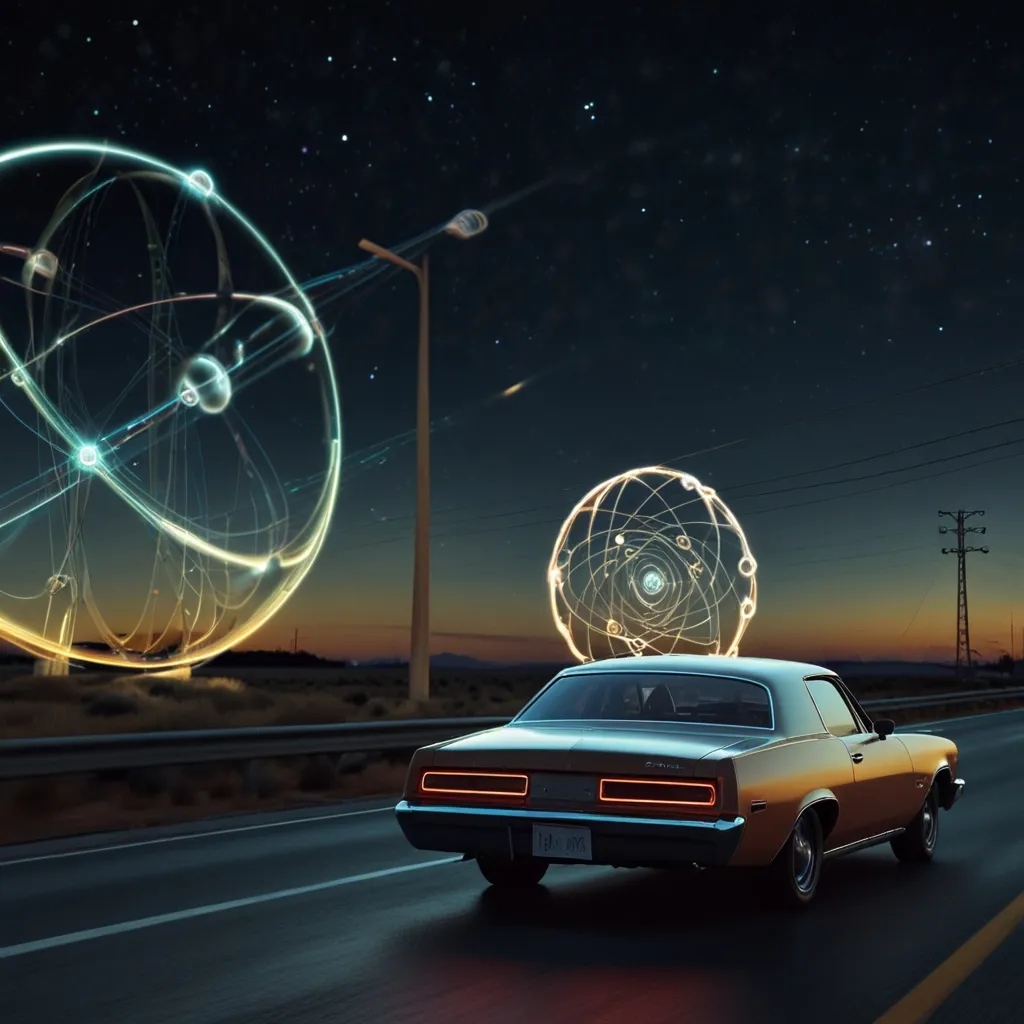
Let’s imagine you’re zipping down the highway at 100 km/h. Your car is buzzing with kinetic energy, which is simply the energy of movement calculated with a straightforward formula from classical physics: ( \frac{1}{2} \cdot \text{mass} \cdot \text{velocity}^2 ). If you weigh 80 kg, you’d have about 31,000 joules of kinetic energy. But what if I told you that just standing still, your energy would exceed over 100 trillion times that amount? The answer lies in Einstein’s famous equation, ( E = mc^2 ).
Most of the mass of an atom is clumped in its nucleus, a minuscule but incredibly dense region. The electrons orbiting the nucleus are negligible in comparison. The mass within atoms is mostly due to interactions with the Higgs field, an invisible energy grid permeating the universe. Elementary particles draw from this field, and the more energy they extract, the more massive they become.
However, it’s not only the Higgs field at play. The strong force, mediated by massless gluons, binds quarks together to form protons and neutrons. This binding energy significantly contributes to an atom’s mass. In essence, mass can be seen as bound energy.
Imagine a Proton consists of three quarks, glued together by the strong force. This force is powerful, more robust than electromagnetism, the weak force, or gravity. The binding energy from the strong force is what makes up 99% of the mass of a proton.
The concept gets even more intriguing when considering a hot object. It’s slightly heavier than the same object when cold, thanks to the energy contributing to its mass. Any confined energy, whether potential or kinetic, affects the mass.
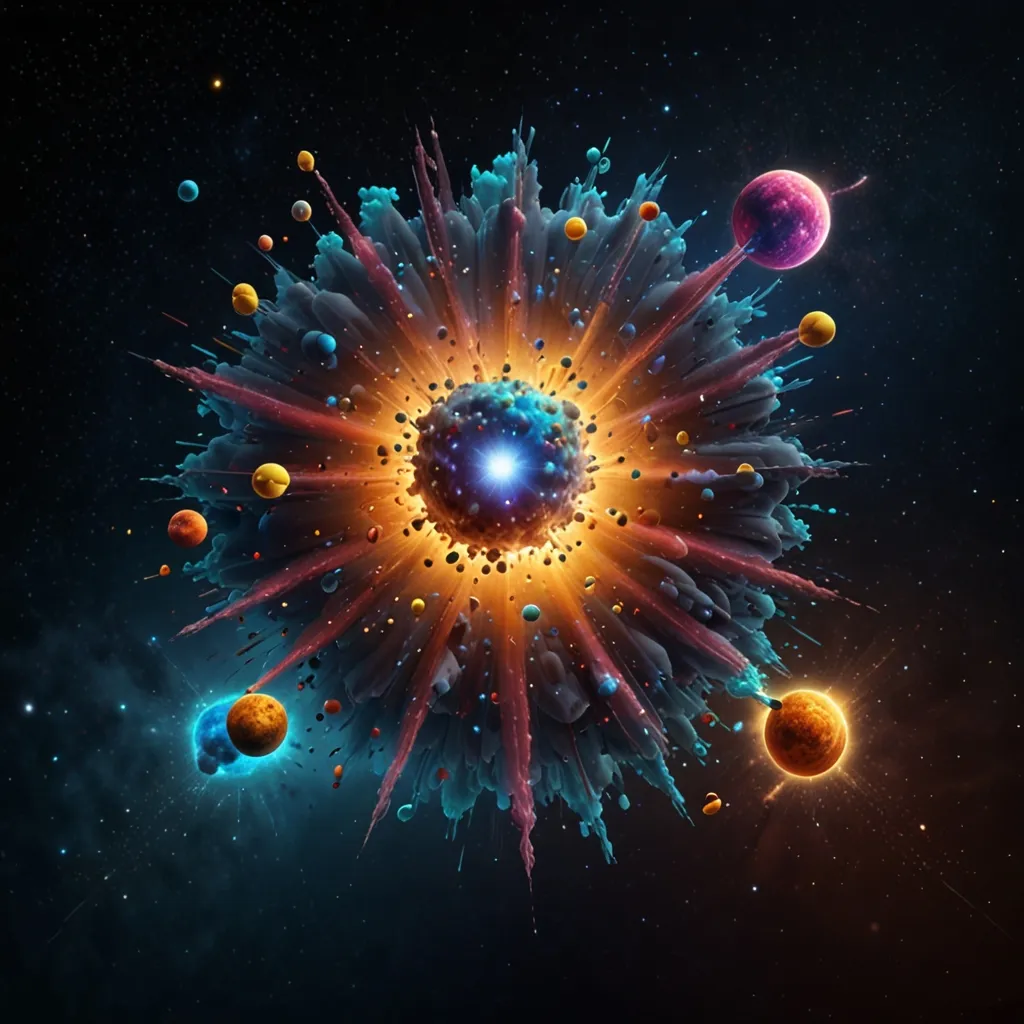
In larger atoms, another force, known as the strong nuclear force, acts between nucleons (protons and neutrons). This force keeps these larger nuclei intact despite the repulsive electromagnetic forces between protons. It’s this type of energy released during a nuclear explosion.
So, the universe’s mass comes from different forms of bound energy, primarily the energy confining quarks. Understanding these interactions provides a glimpse into how the universe creates complex structures, ultimately leading to conscious beings like us. This bound energy manifests as the mass that gives substance to everything, from the smallest particles to the vast expanses of the cosmos.