science

Are You Actually the Center of the Universe?

Exploring the Infinite and Centerless Cosmos
Are You Actually the Center of the Universe?

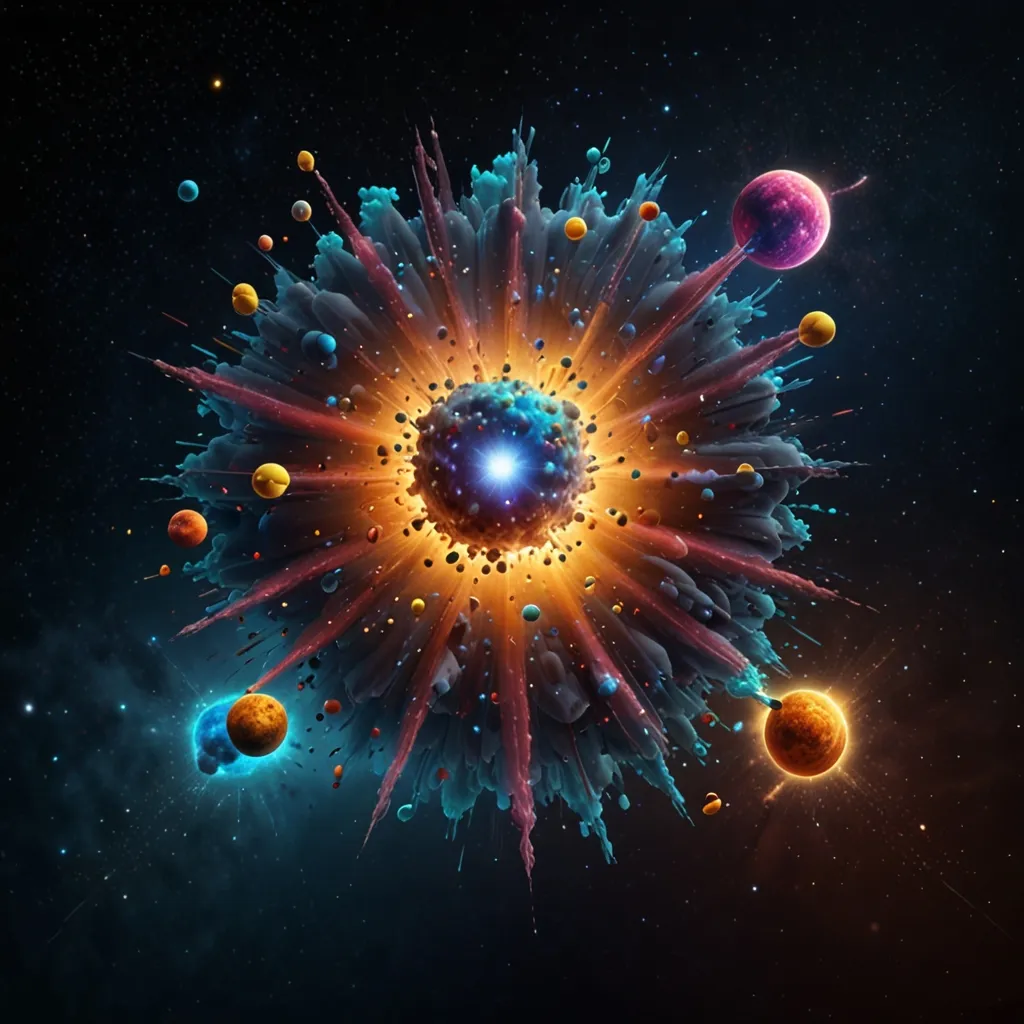
Everything you see around you started with the Big Bang, an unimaginably massive explosion from an infinitesimally small point known as a singularity. This explosion was pure energy, and naturally, we might look for its epicenter, its starting point. So, if the universe began with this colossal explosion, where is the center of the universe? The answer might surprise you: there is no single center—there are infinite centers.

The Big Bang wasn’t an explosion in space; it was an explosion of space itself. Imagine for a moment a balloon. If you think of the two-dimensional surface of the balloon as representing the three-dimensional space of our universe, you can start to visualize this concept. Only the balloon’s surface is our universe; the air inside doesn’t count. The galaxies and points in space we observe are akin to points on this balloon.

Now, picture inflating the balloon. Every point on it moves away from every other point. If you were located on any of these points, you’d think you were at the center of the universe because everything else appears to be moving away from you. This holds true no matter where you are on the balloon’s surface. As the balloon expands, every point appears to be the center from its own perspective.

This is exactly what we observe in the universe—everything is moving away from us. So, on the surface of the balloon, there is no unique center, or every point can be considered the center because of the uniform expansion.

Therefore, the next time someone says, “You’re not the center of the universe,” you can confidently reply, “Actually, I am,” and have science on your side.



Similar Posts
Blog Image
Is Your Extra Sleep Making You Less Sharp?

Finding the Magic Number: The Curious Journey of Sleep and Cognitive Mastery

Blog Image
Is the Universe Racing Towards Another Big Bang?

Cosmic Orchestra: Dark Energy's Role in the Ever-Accelerating Symphony of the Universe

Blog Image
What Can Ancient Rome Teach Us About Modern Toilets?

From Ancient Solutions to Modern-Day Challenges: The Evolution of Human Waste Management

Blog Image
Could the Universe's Mysteries Be Answered by a Single Theory?

Unifikasi Misterius: Mengurai Benang Kusut Alam Semesta

Blog Image
Glowing Waters: Nature's Dazzling Light Show Illuminates Ocean Secrets

Bioluminescent algae create stunning light displays in water. They glow as a defense mechanism, using chemical reactions involving luciferin and luciferase. These microorganisms are vital to marine ecosystems and serve as indicators of ocean health. Their light-producing abilities have applications in biotechnology, medicine, and sustainable lighting solutions. Preserving their habitats is crucial for ocean conservation and future scientific discoveries.

Blog Image
Floating Objects with Sound: The Mind-Blowing Science of Acoustic Levitation

Acoustic levitation uses sound waves to suspend objects in mid-air. It creates a pressure field that counteracts gravity using ultrasound frequencies. This technology has applications in manufacturing, pharmaceuticals, space exploration, and 3D printing. It allows for contactless handling of delicate materials and precise manipulation in zero-gravity environments. While challenging to set up, acoustic levitation shows promise for future innovations in various fields.