Could We Really Unify All Forces of Nature into One?
Unraveling the Cosmic Tapestry: A Journey Through Nature's Fundamental Forces
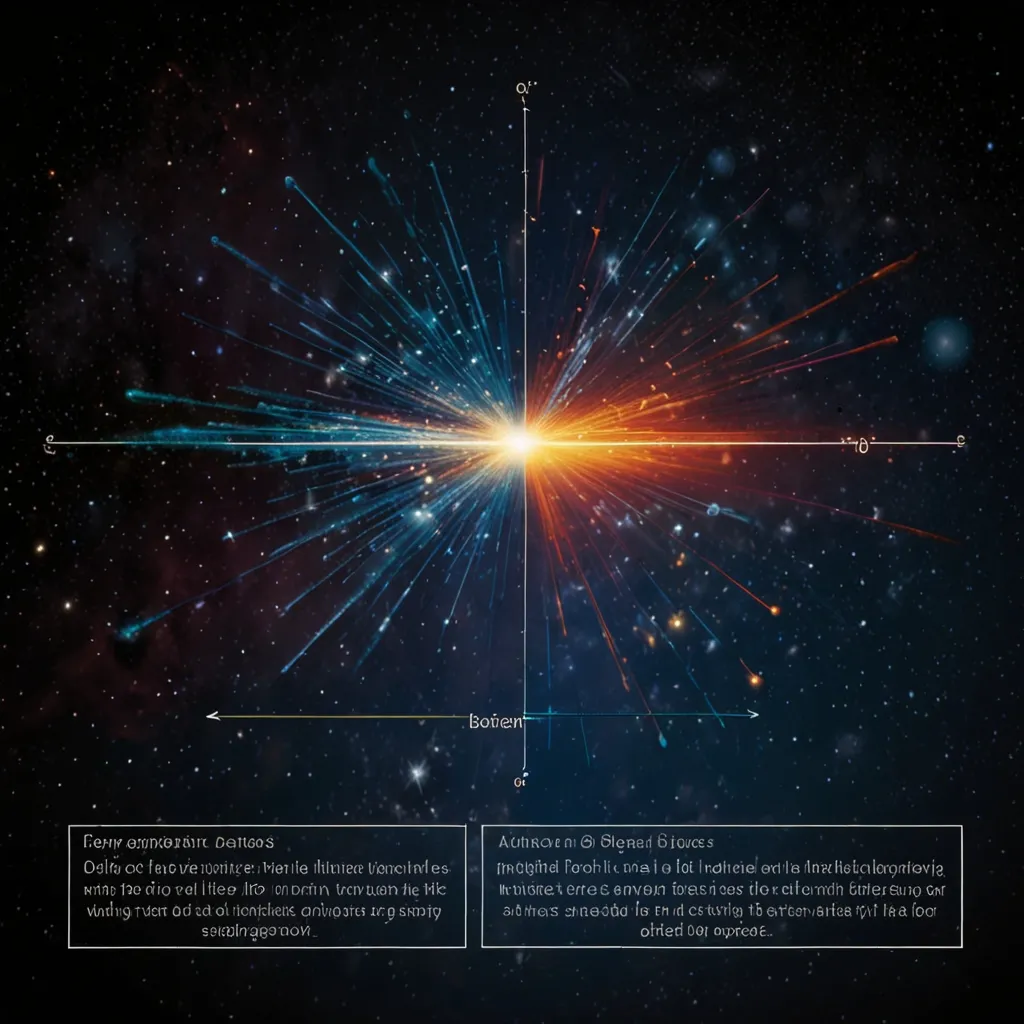
There are four fundamental forces in nature that keep the universe in balance: gravity, the strong nuclear force, the weak nuclear force, and electromagnetism. Gravity keeps you grounded and the moon in orbit. The strong nuclear force holds the nucleus of atoms together. The weak nuclear force is involved in certain types of radiation. Electromagnetism is responsible for light and chemistry. It’s fascinating to think that at the moment of the Big Bang, these four forces were unified as one. As the universe cooled and energy levels dropped, they separated into distinct interactions, starting with gravity at the highest energy levels.
The strong nuclear force came next, detaching at slightly cooler temperatures. What remained was a combined interaction called the electroweak force, which later split into electromagnetism and the weak force at even lower energies. Scientists have been able to simulate the energies of the electroweak force in particle accelerators such as the Large Hadron Collider in Geneva. Modern particle physics provides a robust theoretical basis for understanding this combined force.
It’s mind-boggling that two seemingly different forces—electromagnetism and the weak nuclear force—were once united. Electromagnetism is all around us in visible light and observable chemistry, with infinite range and significant strength. In contrast, the weak nuclear force operates at very short distances, like within the diameter of a proton, and is quite weak. So, how could these two forces be one at a fundamental level?
The answer lies in the Higgs boson, a discovery that has only recently been confirmed. The standard model of particle physics explains much of this. This model is like the periodic table, but for elementary particles. Certain particles, known as gauge bosons, mediate these forces. For example, photons mediate the electromagnetic force, and W and Z bosons mediate the weak nuclear force. Gravity, however, doesn’t neatly fit into this model yet.
For a practical illustration, consider how particles interact. When two electrons repel each other, they do so because they exchange virtual photons. This is akin to two boats pushing apart by throwing basketballs at each other; the basketballs represent the virtual photons. The weak force operates similarly but with different mediating particles like the W and Z bosons.
One critical application of the weak force is in the beta decay of a neutron. This process is vital for nuclear reactions, including those that power the sun. The weak force can even change the identity of particles, like transforming a neutron into a proton.
But a significant challenge in unifying the weak force and electromagnetism is the difference in mass between their mediating particles. Photons are massless, while W and Z bosons are quite massive. How could they have a common origin? Sheldon Glashow and others provided clues by indicating that at extremely small scales, the strengths of these forces appear identical, suggesting a unified point.
Theoretical models predicted an additional gauge boson, the Z boson, and proposed that the weak and electromagnetic forces could be unified under an electroweak theory. However, this theory originally worked only if the particles were massless, which didn’t match observations. This discrepancy was resolved by the introduction of the Higgs mechanism.
The Higgs mechanism, formulated in part by Peter Higgs, explains how particles can gain mass through their interaction with the Higgs field. This field causes particles to fall into a state where they obtain mass, much like objects settling into the lowest point of a landscape. The photon, however, remains massless because its interaction with the Higgs field is different.
This groundbreaking theory is vital for our understanding of the universe and inspires hope that we might one day unify the strong nuclear force with the electroweak force. This grand unified theory would only leave gravity to be understood at a quantum level. Achieving this would give us the ultimate theory of everything, answering many of science’s deepest questions.
Let’s keep pushing the boundaries of knowledge until we unlock all these secrets. The journey to the theory of everything continues.