Can a Smile in One Culture Be a Grimace in Another?
Unveiling the Universality and Cultural Nuances of Human Facial Expressions
The human face has around 40 muscles, which can create thousands of expressions. But do these facial expressions mean the same thing worldwide? Or does a smile in one culture look like a grimace in another?
Charles Darwin thought that emotional expressions were a human universal. He wasn’t in the majority, though. Until the mid-20th century, many researchers believed that people learned how to show emotions differently depending on their culture. Then, personality theorist Silvan Tomkins argued that certain emotional states and their facial expressions are universal.
In the 1960s, psychologist Paul Ekman began testing this idea. He examined hours of film footage of remote tribes with no exposure to modern life. Ekman found that their facial expressions were not only familiar but also occurred in the expected situations. He also ran tests with isolated tribes, and they correctly linked photos of facial expressions with stories meant to trigger specific emotions. This research backed up Darwin’s theory that some vital emotional expressions are universal.
However, how intensely we show these expressions can vary greatly between cultures. Researchers even studied facial expressions in people born blind. They guessed that if expressions were universal, blind people would show them just like sighted people. And they were right. Both blind and sighted athletes displayed the same emotional expressions when they won or lost matches.
We can see more evidence by looking at our evolutionary relatives. Facial expressions in humans and non-human mammals show similarities in muscle movement and structure. For instance, chimpanzee laughter looks different from ours but uses similar muscles.
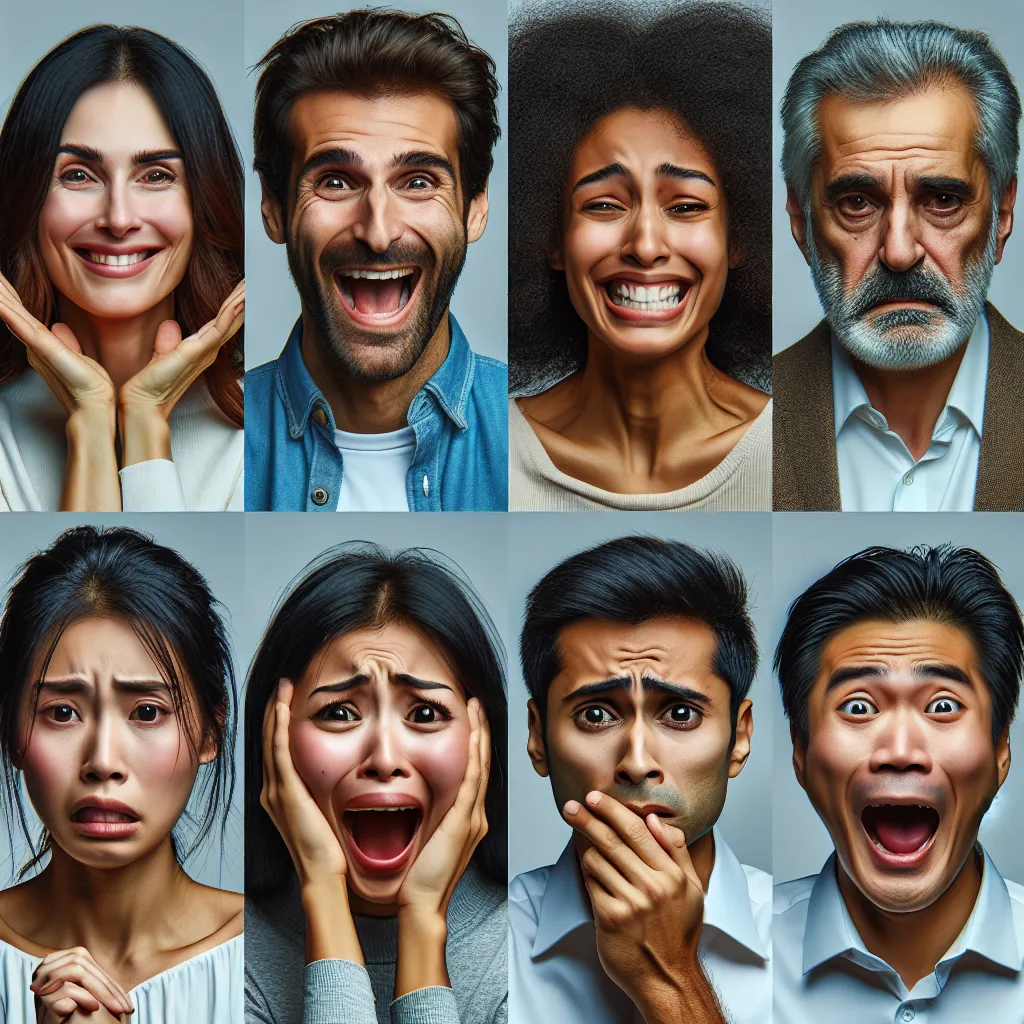
Back in the 60s, Ekman identified six core expressions. Anger shows with lowered, drawn-together eyebrows, tense eyes, and tight lips. Disgust makes the lips pull up and the nose crinkle. Fear reveals the upper white of the eyes, with raised eyebrows and a stretched-open mouth. Surprise looks like fear but with rounded eyebrows and relaxed lips. Sadness includes inwards-drawn eyebrow corners, drooping eyes, and a downturned mouth. Happiness shows with upturned lips and raised cheeks, causing eye wrinkles.
Researchers have since suggested more expressions like contempt, shame, and disapproval, but opinions differ on how distinct these categories are.
So why are some expressions universal, and why do we make them in these particular ways? Scientists think our evolutionary history holds the answers. Some expressions may have been crucial for survival. Fear and surprise, for example, can signal immediate danger to others. Studies show we pay more attention to threatening faces, especially when we’re on high alert.
Expressions also might help improve group survival by showing our internal states. Sadness, for example, signals to the group that there’s a problem. Some evidence even links expressions directly to our physiology. Fear expressions might help us survive by preparing our eyes and lungs for a fight or flight response.
There’s still a lot to learn about emotional expressions and our brain’s inner workings. But if you find yourself among strangers in a new place, a friendly smile could be a universal way to connect.