What If Light Didn't Play By The Rules?
The Enigmatic Dance of Light and the Secrets of the Universe's Speed Limit
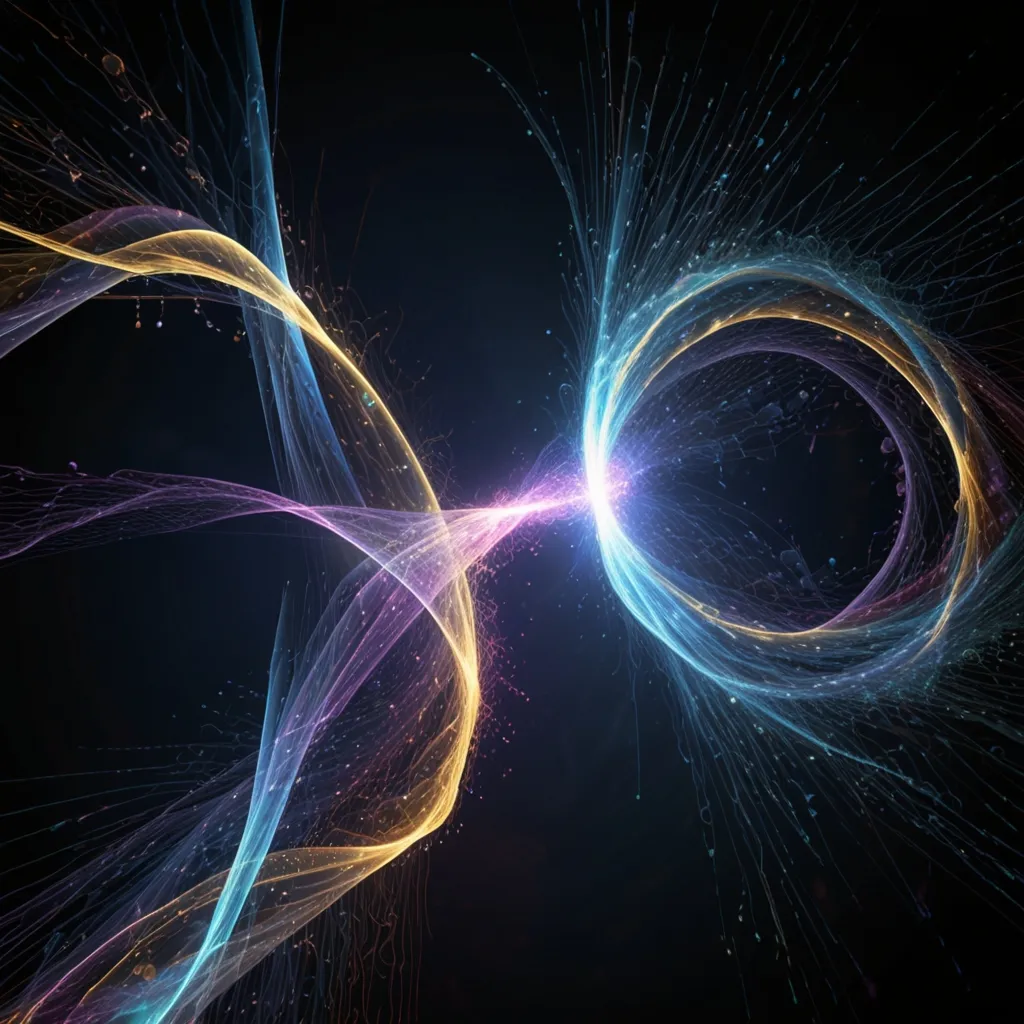
In the history of physics, light has always been a bit of an enigma. Initially, there was a great debate over whether light was a particle or a wave. This duality puzzled scientists for years. Early experiments, like the slit tests, showed light behaving as a wave. Conversely, phenomena such as the photoelectric effect showcased its particle-like properties.
Max Planck’s work around 1900 was groundbreaking. He developed the theory of black body radiation, which required that light be quantized. This was a major leap in understanding light as fundamentally a quantum object. Essentially, light behaves mostly like a wave but can exhibit particle-like traits during measurement. To describe it accurately, we use the wavefunction within the Schrödinger equation.
But then came another intriguing question: how does light propagate if it’s a wave? Sound needs air to travel; what about light? Classical physics introduced the concept of ether, a hypothetical medium filling all space for light and gravity to propagate through. However, Albert Einstein’s theory of special relativity in 1905 debunked this idea. He posited that light travels at a constant speed in a vacuum, void of any medium, marking the maximum possible speed—the speed of light.
The universe has this upper speed limit instead of an infinite one because this finite speed is dictated by vacuum permittivity and permeability—fundamental properties of empty space. These constants denote space’s resistance to the propagation of electromagnetic waves, which light indeed is. If this resistance was absent or minimal, light could travel infinitely fast, leading to a bizarre and instantaneously connected universe.
If information traveled instantaneously, an event anywhere in the universe could affect everywhere else at the same moment. This would eradicate the concept of locality, where objects affect only their immediate surroundings. The finite speed of light keeps these influences local, maintaining the universe’s coherent functionality.
Moreover, causality—the principle that cause precedes effect—is sustained by light’s speed limit. Einstein’s Special Relativity tells us there’s no simultaneity in the grand scheme of spacetime. With an infinite speed of light, this ordering would break down, obliterating our sense of history and the cause-effect fabric we perceive.
Without this speed limit, mass, as we know it, might not exist. Rearranging Einstein’s famous equation E=MC^2 shows that with an infinite speed of light (C), we’d need infinite energy to create any mass. This means our physical universe, and life as we understand it, couldn’t exist.
It’s fascinating to consider what happens if the speed of light varied or was infinite. Our foundational theories, including relativity and quantum field theory, would crumble. We’d return to pre-1900 classical physics. Light’s speed is constant in a vacuum and is observer-independent. This means regardless of an observer’s movement, the speed of light remains the same—a critical pillar in maintaining the universal speed limit.
Ultimately, the universe doesn’t prioritize the speed of electromagnetic waves but cares deeply about causality. This speed is the quickest that information can flow, tying directly to light’s maximum speed since photons, having no rest mass, aren’t restricted in speed. This constancy in light’s speed ensures a consistent conversion factor linking space and time—one of the profound truths of our universe’s fabric.
This interplay between space and time, mediated by light’s speed, is crucial to understanding our reality. It’s not just an interesting number like the speed of sound but a fundamental characteristic linking the very fabric of spacetime. The specific number (the speed of light) isn’t crucial as long as it’s constant and finite, ensuring a coherent and causally connected universe.