How Did Ancient Egyptians Tackle Decay and Taxed Mummies as Salted Fish?
Mummified Mysteries: The Ingenious, Gruesome Artistry of Ancient Egyptian Preservation
Death and taxes are famously unavoidable, but what about decomposition? While ancient Egyptians went to great lengths to dodge decomposition, using intricate mummification techniques, how effective were they really?
Living cells are in a constant state of renewal. They use specialized enzymes to break down old structures and repurpose the raw materials to build new ones. When a person dies, their cells lose the ability to renew themselves, but the enzymes continue breaking things down. So, if someone wanted to preserve a body, they had to act fast.
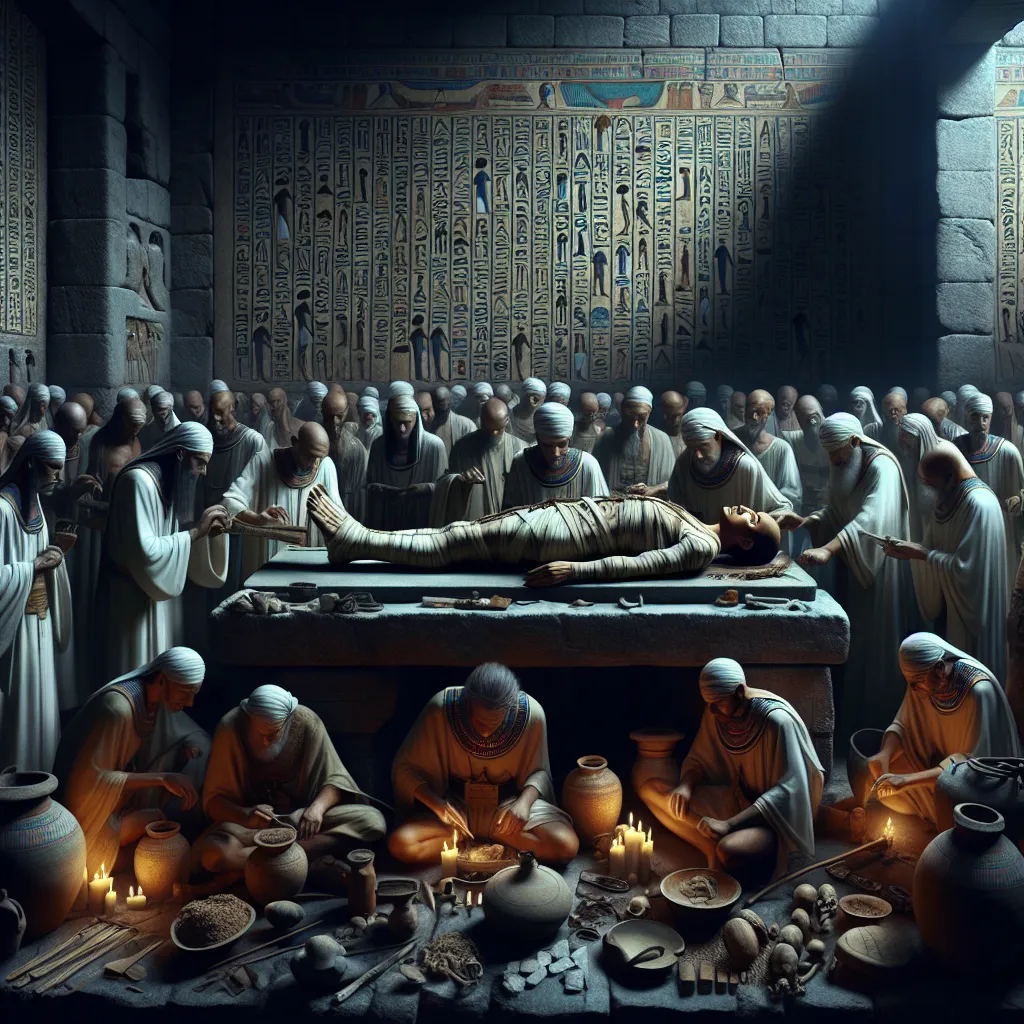
Ancient Egyptian mummifiers knew brains would decay quickly. According to the Greek historian Herodotus, they addressed this by hammering a spike into the skull, mashing up the brain, and flushing it out through the nose. They then poured tree resins into the skull to stave off further decomposition.
While brains decay fast, the situation with internal organs is even more dire. The liver, stomach, and intestines are filled with digestive enzymes and bacteria that begin eating the body from the inside after death. As a result, mummifiers removed the lungs and abdominal organs first. They handled the heart with special care because it was considered the soul’s seat. The organs were placed in jars filled with natron, a naturally occurring salt. Natron, which consists of soda ash and baking soda, kills bacteria and prevents digestive enzymes from working.
After removing the internal organs, the priest stuffed the body cavity with sacs of more natron and cleaned the skin. The corpse was then placed in a bed of natron for about 35 days, allowing the salt to draw out fluids and form hard brown clumps.
Once this process was completed, tree resin was poured over the corpse to seal it. The priests massaged the body with a waxy mixture that included cedar oil, then wrapped it in linen. Finally, the mummy was placed in a series of nested coffins, sometimes within a stone sarcophagus.
So, how did ancient Egyptians fare in their quest to defeat decay? Mummies aren’t perfect replicas of the living bodies they once were—they have mashed brains, removed organs, and greatly reduced body mass. However, what remains is remarkably well-preserved. Even after thousands of years, scientists can perform autopsies on mummies to ascertain causes of death and possibly isolate DNA samples.
This preservation has led to some fascinating discoveries. For instance, it appears air pollution was a significant issue in ancient Egypt, likely from indoor fires used to bake bread. Cardiovascular disease and tuberculosis were also common.
Even though they managed to preserve bodies reasonably well, ancient Egyptians couldn’t entirely escape the inevitable march of decay. Interestingly, when some mummies were transported, they were taxed as salted fish, underscoring that even mummies couldn’t evade the reach of taxes.