Can You Imagine a Ship the Size of a Mountain?
The Titanic of the Ancient World: Archimedes' Engineering Marvel
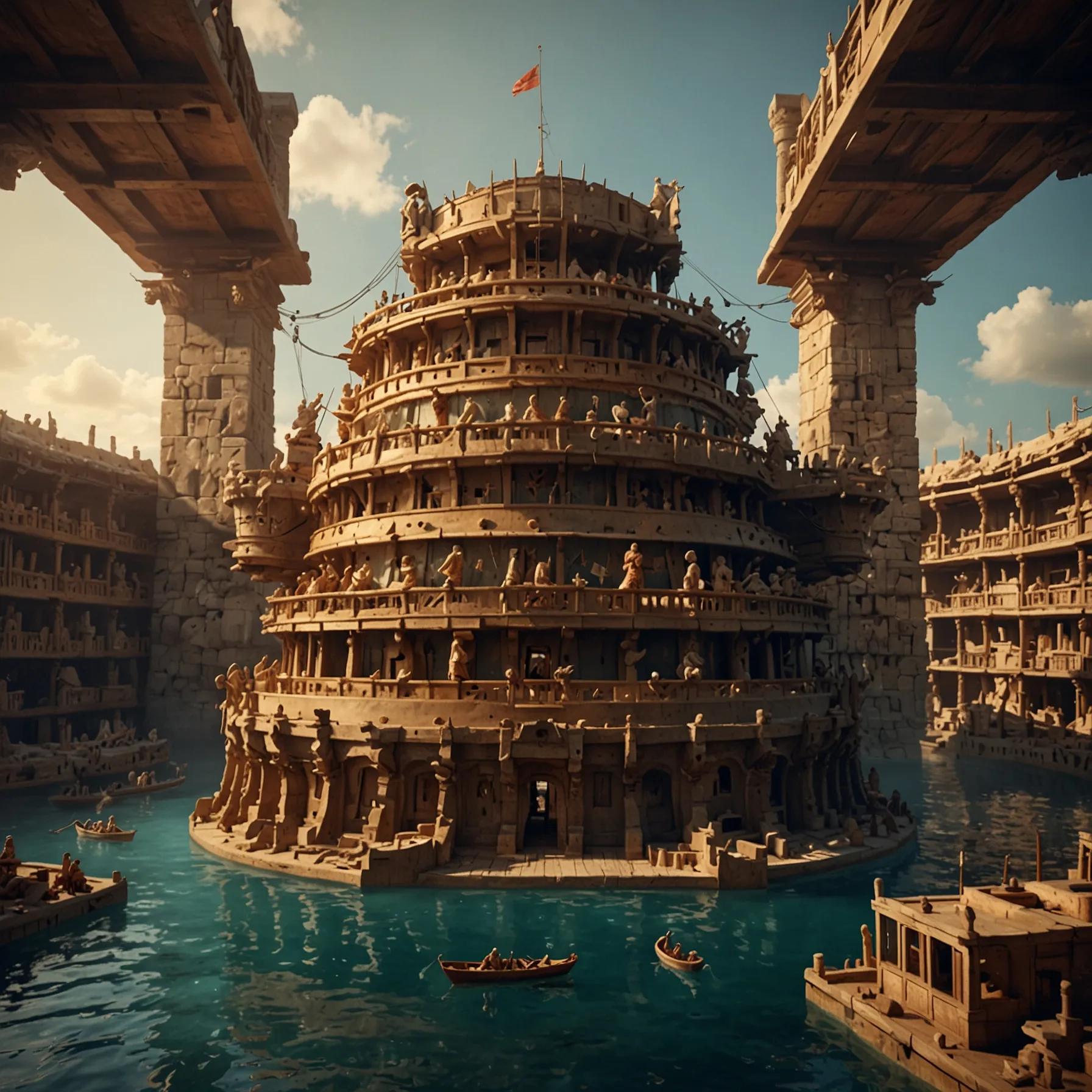
When you think of Archimedes’ “Eureka!” moment, you probably picture him jumping out of a bathtub. But there’s another story that’s even more fascinating. Back in the third century BC, Hieron, the king of Syracuse, chose Archimedes for an epic engineering challenge. Hieron wanted a gigantic ship, 50 times bigger than a standard warship, named Syracusia, as a gift for Egypt’s ruler, Ptolemy. But could such a massive vessel float?
In Archimedes’s time, no one had ever attempted something like this. It was like asking if a mountain could fly. Hieron put everything on the line for this venture. Workers spent years building Syracusia, using pine and fir from Mount Etna, hemp ropes from Spain, and pitch from France. The top deck was designed to support eight watchtowers and was to be adorned with wooden figures of Atlas holding the world. The bow featured a massive catapult capable of launching 180-pound stone missiles.
For the passengers’ comfort, the ship included a flower-lined promenade, a sheltered swimming pool, a bathhouse with heated water, a library, a temple to the goddess Aphrodite, and a gymnasium. And if that wasn’t enough, Hieron intended to fill the ship with 400 tons of grain, 10,000 jars of pickled fish, 74 tons of drinking water, and 600 tons of wool. In total, it carried over a thousand people, including 600 soldiers, and housed 20 horses.
The stakes were high for Archimedes. Failure wasn’t an option. One day, possibly while relaxing in a bathhouse, it struck him. An object partially immersed in water is buoyed up by a force equal to the weight of the water it displaces. To simplify, if the 2,000-ton Syracusia displaced 2,000 tons of water, it would float. If it displaced 4,000 tons, it would float even better. But if it only displaced 1,000 tons, it would sink. This discovery, known as Archimedes’ Principle, explains why massive ships float as easily as small boats or even bathtubs.
Interestingly, this story might be mixed up with another famous tale involving Archimedes and a crown. The Greek word for keel, “korone”, is quite similar to the Latin word for crown, “corona”. Perhaps history just muddled the details.
When Syracusia finally reached Egypt, residents of Alexandria must have been awestruck by the magnificent floating palace arriving in their harbor. This incredible vessel was like the Titanic of the ancient world, minus the sinking, all thanks to Archimedes.