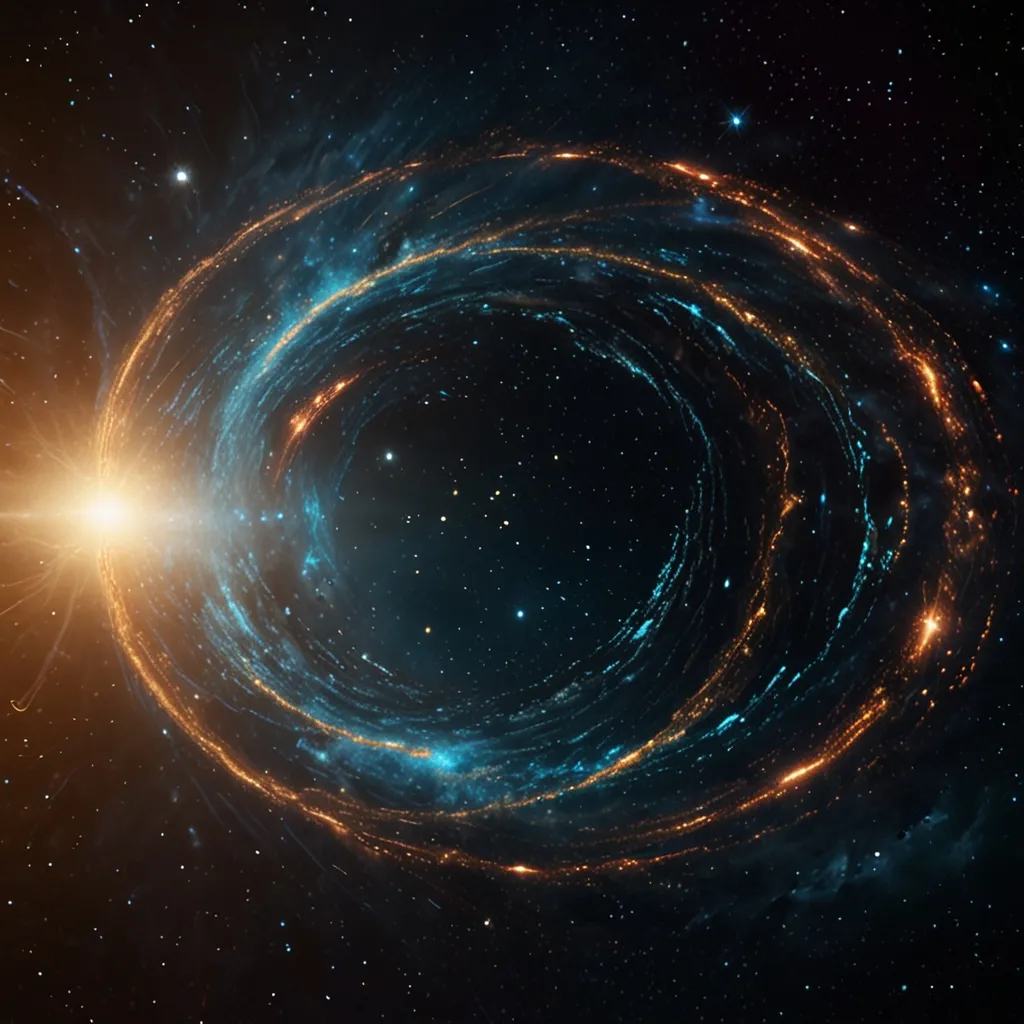
Over a hundred years ago, Albert Einstein’s theory of general relativity fundamentally changed our understanding of the universe. This groundbreaking theory didn’t just explain the mystery of Mercury’s orbit; it gave us insight into phenomena like black holes, gravitational waves, and light bending around massive objects. One intriguing concept born from Einstein’s equations is the theoretical possibility of faster-than-light travel via a warp bubble.
But what about the tantalizing idea of traveling back in time?
Einstein’s field equations offer tantalizing solutions for time travel, particularly through constructs known as wormholes. If real, these tunnels in space-time could connect two distant points, effectively providing a shortcut. This shortcut could theoretically allow someone to travel vast distances faster than light, or even traverse different time periods.
Kip Thorne, a renowned physicist, devised an ingenious thought experiment using a hypothetical stable wormhole. Imagine, in the year 2200, we create such a wormhole in a lab on Earth. We then transport one end of it on a spaceship capable of nearly-light-speed travel. If the spaceship travels for a year at 99.5% the speed of light, upon its return, due to time dilation, only one year will have passed for the astronaut and wormhole on the ship, while ten years will have passed on Earth. This discrepancy allows for the peculiar situation where you can step into the wormhole at the spaceship end and emerge ten years in the past.
The concept is visually captivating but faces numerous theoretical and practical obstacles. For instance, no wormholes have been confirmed to exist naturally. Additionally, creating and maintaining one would require exotic matter with negative energy density, a substance that we have yet to discover or produce in large quantities.
Remarkably, scientists like Juan Maldacena and Alexi Malenkin have proposed unconventional methods to create these wormholes. Some theories involve charged black holes or cosmic strings, which are theoretical one-dimensional defects left over from the Big Bang.
However, even if we overcome these hurdles, a wormhole-based time machine would only allow travel back to the moment the wormhole was first created. This answers why we don’t see time travelers from the future—they can’t travel farther back than the inception of the wormhole.
Considering the technical challenges and unknowns, creating a viable wormhole for time travel remains within the realm of theoretical physics, a fascinating but unproven concept. Regardless, the idea reminds us how precious our current moments are—each one irreplaceable and unique.
In summary, while the dream of time travel excites our imagination, making it a reality involves monumental scientific breakthroughs. Until then, we get to cherish our current moments, living them to the fullest, knowing they are our very own slivers of eternity.