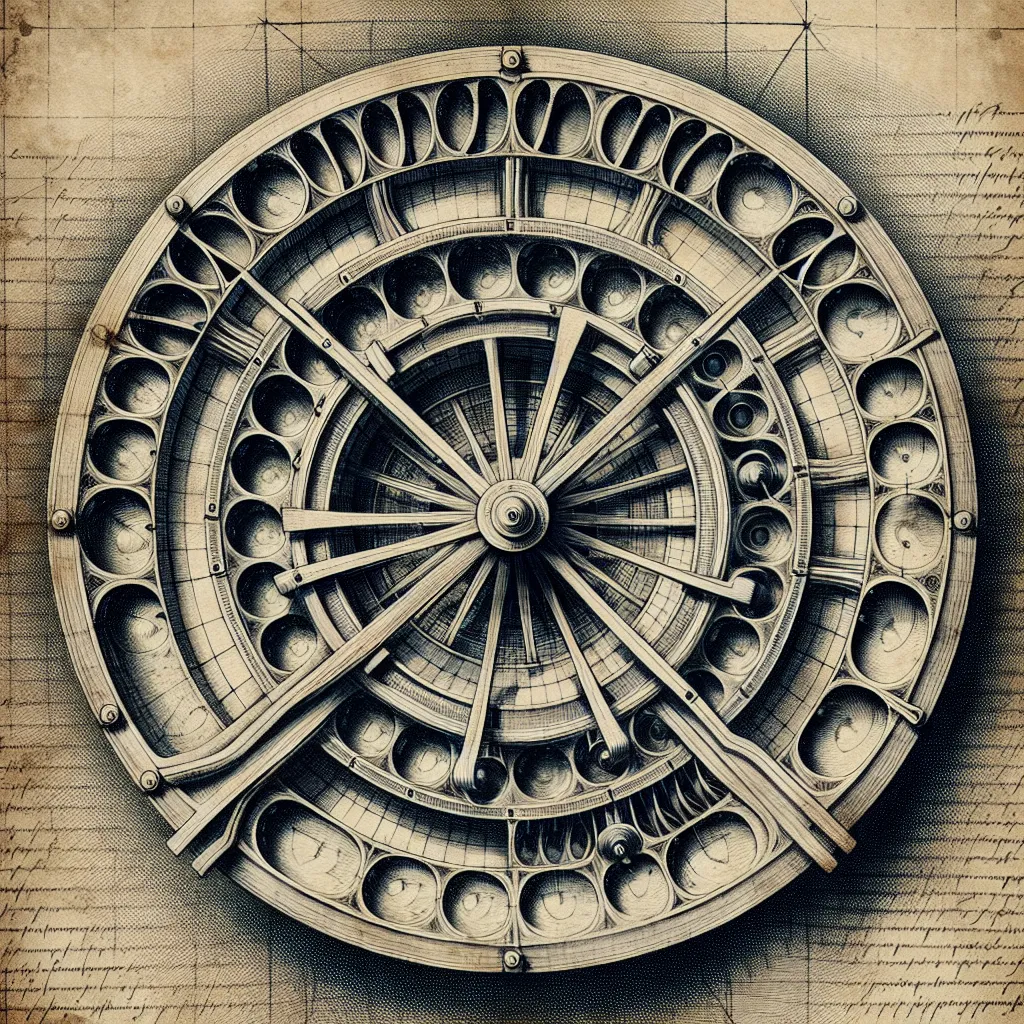
Around 1159 A.D., a brilliant mathematician named Bhaskara the Learned came up with a remarkable design. He drew a wheel with curved compartments filled with mercury. His idea was simple yet fascinating: as the wheel turned, the mercury would flow to the bottom, making one side of the wheel heavier. This imbalance would keep the wheel spinning forever. It’s one of the earliest concepts for a perpetual motion machine—a device that could work indefinitely without any external energy.
Imagine a windmill that generates its own wind or a lightbulb that powers itself. Such inventions could revolutionize how we use energy. If we could create a perpetual motion machine that included humans, it might even sustain life forever. The catch? These machines don’t work. They defy the fundamental laws of thermodynamics, the branch of physics that deals with different forms of energy.
The first law of thermodynamics states that energy cannot be created or destroyed. You can’t get more energy out than what you put in. This automatically rules out any useful perpetual motion machine since it would only produce as much energy as it consumed, leaving none for other uses like powering a car or charging a phone.
Inventors, however, have never stopped dreaming. Bhaskara’s over-balanced wheel has inspired many variations over the centuries, but none of them function as intended. The wheels just end up swinging back and forth like a pendulum before stopping. Another inventive mind, Robert Boyle, in the 17th century, thought of a self-watering pot using capillary action. But again, the idea didn’t pan out because the same force that pulled the water up would also prevent it from falling back.
Magnets have also been tried. In one version, a ball is supposed to be pulled up by a magnet and then fall back down to start the cycle again. However, the magnet merely holds the ball at the top, failing to complete the cycle. Even if the ball did keep moving, the magnet’s strength would decline over time.
For perpetual motion to work, these machines would need to generate extra energy, violating the first law of thermodynamics. Some machines may seem to keep going, but they’re always secretly drawing energy from an external source.
Even if we somehow respected the first law, the second law of thermodynamics would still trip us up. This law states that energy tends to spread out through processes like friction. Any real machine would have moving parts or interactions with air or liquids generating heat and friction. This heat is energy escaping, gradually depleting the available energy until the machine stops.
These two laws of thermodynamics have halted every attempt at creating a perpetual motion machine so far. Despite this, it’s hard to say we’ll never achieve it because the universe still holds many mysteries. We might discover new materials or even find perpetual motion on a tiny, quantum scale. What we’re sure of is that the quest for perpetual motion remains infinite. For now, the real perpetual motion is our unending search for it.