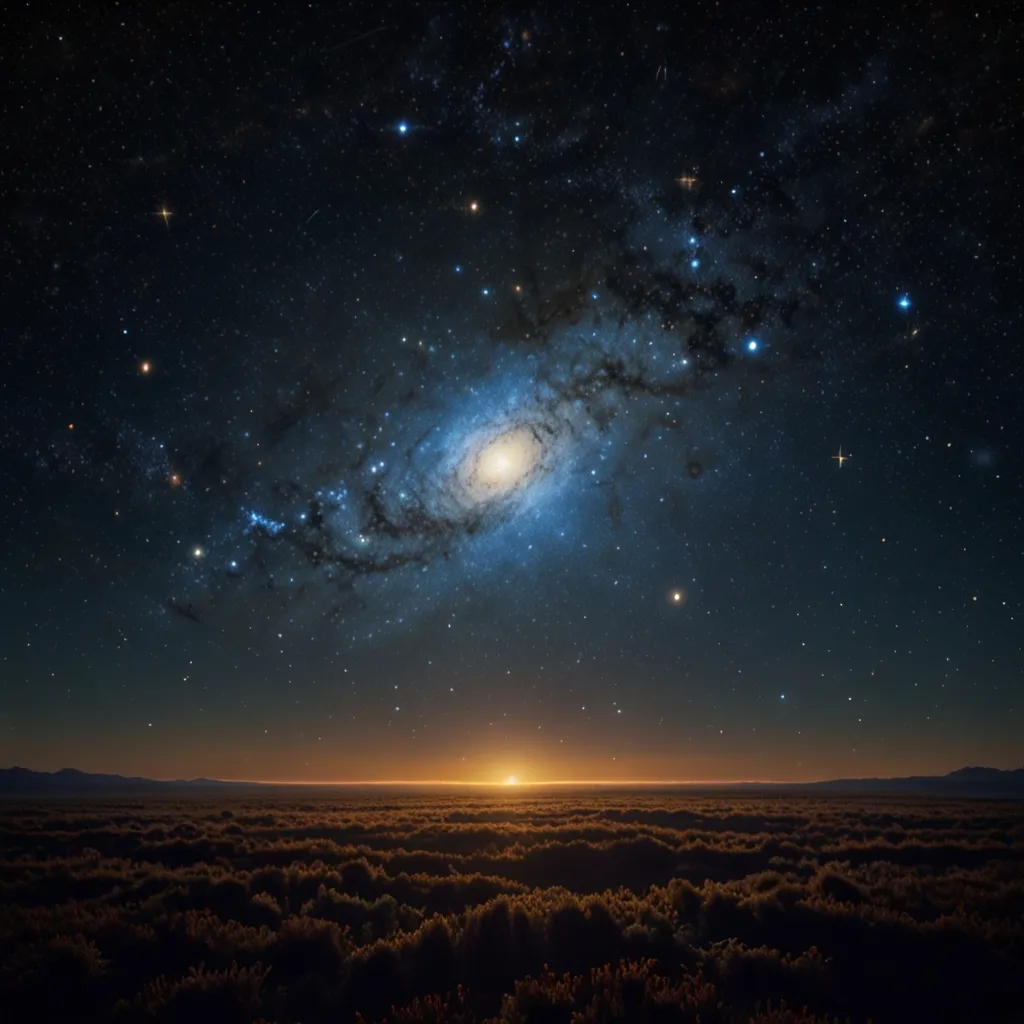
This remarkable photograph, taken by Voyager 1 beyond Neptune’s orbit as it was exiting our solar system, is possibly one of the most humbling images humans have ever seen. Carl Sagan eloquently described our Earth in this image as a “mote of dust suspended in a sunbeam,” highlighting our smallness in the vast universe. Similarly, the Hubble Deep Field image, showing over 10,000 galaxies in a minuscule fragment of the sky, further deepens this sense of cosmic humility.
The Milky Way itself, our home galaxy, is composed of up to 400 billion stars and roughly as many planets. Our Sun, an ordinary star, sits about halfway out from the galactic center. Earth orbits this unremarkable star, tucked away in a remote corner of the vast universe. Humans, but one of at least nine million species on Earth, ponder their significance in this celestial expanse.
So, what does this mean for us? Are we just insignificant specks, or is there more to our existence? To grasp our place in the cosmos, we need to consider the improbability of our existence. The universe started 13.8 billion years ago with the Big Bang. If the universe had expanded slightly differently, the matter may never have coalesced into stars and galaxies, let alone planets or living beings.
Around 200 million years post-Big Bang, the first stars lit up, eventually exploding and enriching the universe with heavier elements. These elements formed nebulae, which birthed new generations of stars. Our Sun formed from one such nebula, surrounded by rocky planets with sufficient heavy elements.
One of these planets, Earth, was at just the right distance from the Sun for liquid water to exist. This allowed complex molecules, particularly carbon-based ones, to interact in ways conducive to life. Over billions of years, these interactions led to the evolution of diverse life forms through natural selection.
Earth’s story involves celestial luck too. Jupiter, a massive planet, acted as a shield, reducing asteroid impacts that could have wiped out emerging life. The formation of our Moon, stabilizing Earth’s axial wobble, ensured predictable climates, aiding the development of diverse ecosystems.
Human evolution itself is a series of fortunate events. From the extinction of dinosaurs, allowing mammalian ancestors to thrive, to the climatic shifts in Africa that nudged tree-dwelling apes towards life on the plains, every twist of fate was crucial for our existence.
The laws of physics and universal constants have permitted atoms to form, and chemistry to unfold, setting the stage for life. Considering these myriad lucky breaks, it’s clear we’ve hit the cosmic jackpot. Despite the imperfections and hardships of life, our mere existence is a stroke of improbability.
While we may never uncover what existed before the Big Bang, it’s essential to appreciate the comprehensible nature of the universe, as Einstein marveled. We are not just inhabitants; we are part of the cosmos, capable of perceiving and questioning our existence.
It’s tempting to ponder whether other intelligent beings exist. Despite the vast number of stars and planets, no concrete evidence of intelligent extraterrestrial life has emerged. Enrico Fermi’s paradox, “Where are they?” underscores the rarity of intelligent life.
Thus, recognizing our possibly unique and rare existence, it becomes crucial to cherish and protect our planet. As Carl Sagan suggested, we are the custodians of life’s meaning. Our improbable existence grants us the privilege to connect with and understand the universe.
In our quest for knowledge and understanding, let us strive to be that shining speck of dust in the vast cosmos, seeking enlightenment and embracing our unique role in the grand tapestry of existence.