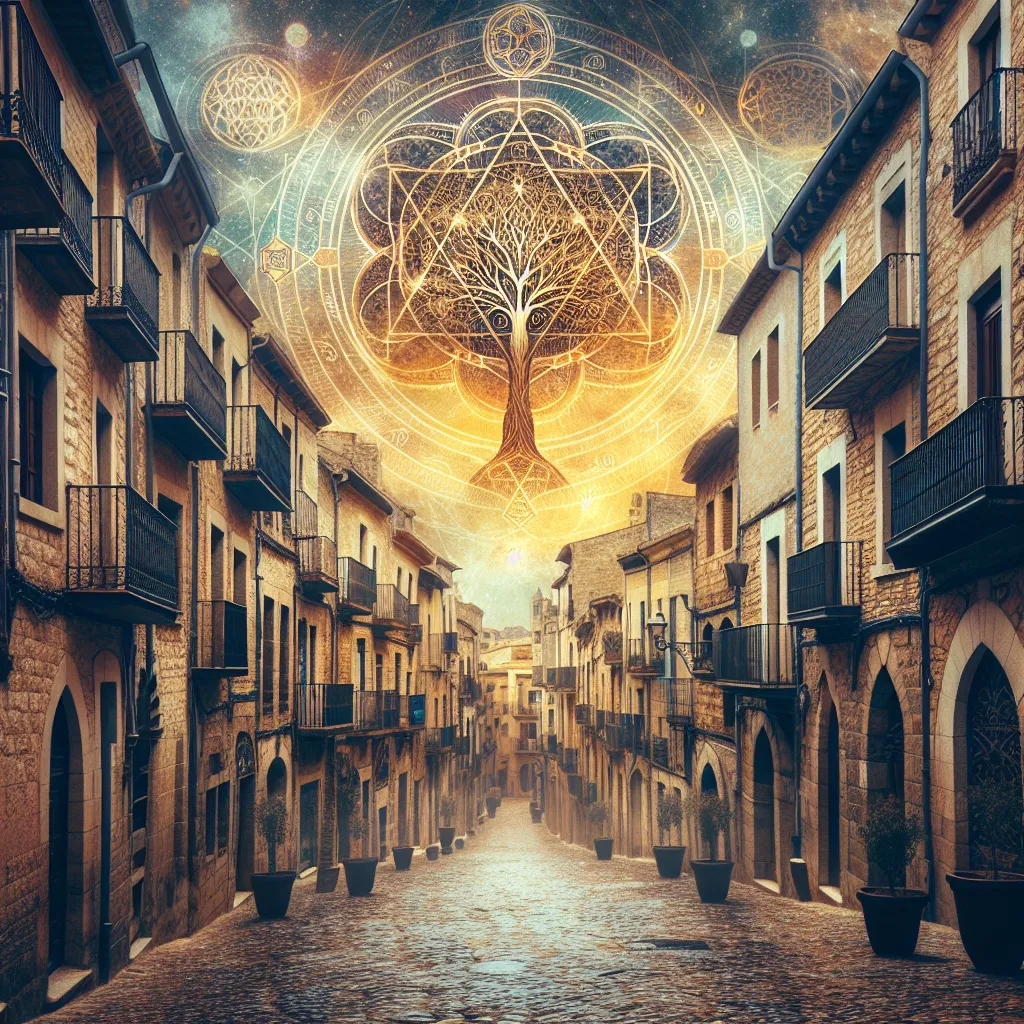
I recently visited Girona, a charming town in Catalonia near Barcelona. Beyond its picturesque streets and rich history, Girona holds special significance for its role in the history of Kabbalah. This town is where some foundational teachings of Kabbalah first took shape.
Isaac the Blind, considered the first Kabbalist, lived nearby in Provence, France. His most influential students, however, were based in Girona. Among them, Azriel of Girona stands out as a pivotal figure. He expanded on Isaac the Blind’s teachings and penned numerous works on Kabbalah before the famous Zohar emerged. Azriel is credited with systematizing the concept of the “ein sof” (the Infinite) and the “sefirot”—divisions of divine emanations. Drawing from Neoplatonic philosophy, he articulated these ideas in a way that made them some of the most iconic elements of Kabbalah.
The Kabbalists focused on two main areas: the mystical meanings behind Jewish commandments and the divine realm represented through the sefirot. The sefirot are often depicted as the Tree of Life, symbolizing different stages of God’s emanations from the hidden infinite to the physical world. At the top—or even beyond this tree—exists the “ein sof,” God in an absolute, unknowable form.
Azriel of Girona laid out these profound ideas, blending earlier Jewish mystical texts with neoplatonic thought. His work provided a framework that fueled the development of Kabbalah in later years, especially with the creation of the Zohar in Castile by Moses de Leon and his associates.
Girona also produced Moses ben Nahman, or Nahmanides, an illustrious scholar and student of Azriel. Known for his significant Bible commentary, Nahmanides subtly infused Kabbalistic themes into his interpretations. His work further cemented Girona’s place in the history of Jewish mysticism.
Walking through Girona today, one can’t help but feel the weight of history, especially within its well-preserved Jewish quarter. Though the expulsion of Jews from Spain in 1492 darkened this chapter, efforts since the 1970s have restored parts of the Jewish quarter, allowing visitors to explore and feel connected to its spiritual heritage.
Kabbalah has seen various stages of evolution, from its roots in ancient Jewish mysticism to its modern-day prominence. Cities like Girona remind us of the importance of these historical moments, etched in the town’s architecture and streets. For anyone interested in Kabbalah, or Jewish history in general, Girona offers a captivating journey through time.