When we study a religion like Islam from a historical and scholarly angle, it’s essential to understand the historical context in which it emerged. The Prophet Muhammad, whose teachings are the foundation of Islam, lived and preached in 7th-century Western Arabia. But what was Arabia’s religious landscape before the arrival of Islam?
Many people believe the simplistic narrative that pre-Islamic Arabs were all polytheistic pagans who worshipped multiple gods until Islam converted everyone to monotheism. Historically, sources like the Seerah literature and “Kitab al-Islam” by Hisham ibn al-Kelbi, written centuries after the Prophet’s life, shaped this understanding. However, these sources have significant biases, aiming to legitimize Islam by portraying pre-Islamic Arabs as backward.
In modern times, archaeological discoveries have given us a more nuanced view. Recent scholarship and excavations in Northern Arabia and across the Arabian Peninsula have revealed diverse and complex religious traditions. Many rock inscriptions provide firsthand accounts of the culture, tradition, and religion of ancient Arabs.
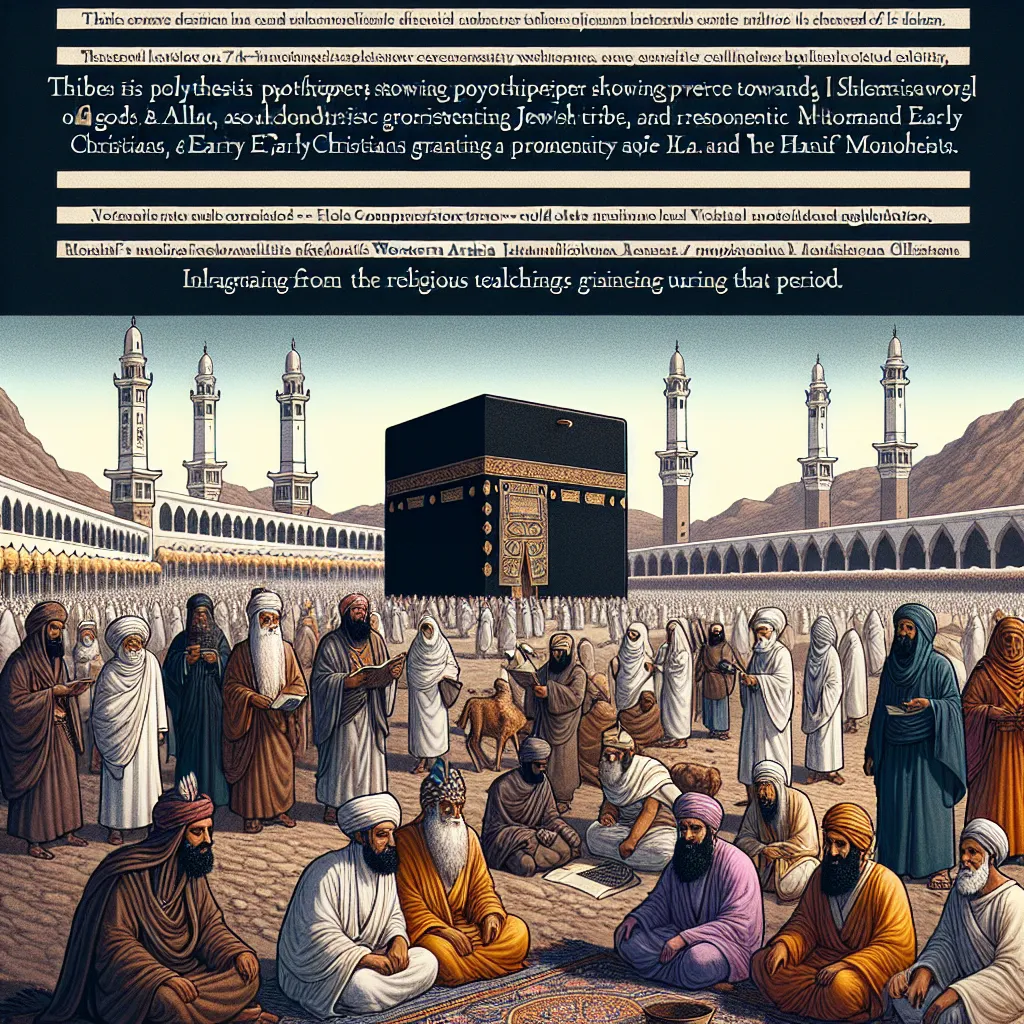
Arabia, situated between the Byzantine (Christian) and Sassanian (Zoroastrian) Empires, was vibrant and involved in larger historical events. The region housed numerous tribes, including the Lahmids allied with the Sassanian Empire and polytheistic, and the Ghassanids allied with the Byzantine Empire and predominantly Christian. This diversity extended to religious practices, with most inhabitants worshipping multiple deities.
Archaeological evidence shows that pre-Islamic Arabs worshiped various local and universal gods. For example, the god Shems represented the sun, while Allat, a goddess akin to Aphrodite and Ishtar, played a significant role. The moon god Rudaw and Baal, a deity of rain and storm, were also prominent.
Beyond polytheism, monotheistic beliefs also existed. By the 4th and 5th centuries, Jewish tribes, Christians of different denominations, and possibly independent monotheistic groups called Hanifs coexisted in Arabia. Cities like Mecca were largely polytheistic, while places like Yathrib (later Medina) had significant Jewish communities.
The name Allah, central to Islam, originates from the term “al-ilah,” meaning “the god.” Evidence shows early Christian Arabs referred to their god with this term. It appears that some Arabs might have worshiped Allah alongside other deities, reflecting a form of monotheism less strict than Muhammad’s later teachings.
Pre-Islamic practices such as pilgrimage (Hajj) to shrines like the Kaaba and ritual ablutions can also be traced to this era. Notably, an inscription from Yemen in 2018 resembled the opening phrase of Quranic chapters, indicating monotheistic traditions pre-dated Islam.
In summary, pre-Islamic Arabia was a melting pot of religious traditions. Polytheism was prevalent, but monotheistic groups were also influential. Understanding this diverse context helps us appreciate the emergence of Islam and the transformative role of the Prophet Muhammad. This rich tapestry of beliefs set the stage for a new monotheistic religion that would change the course of history.