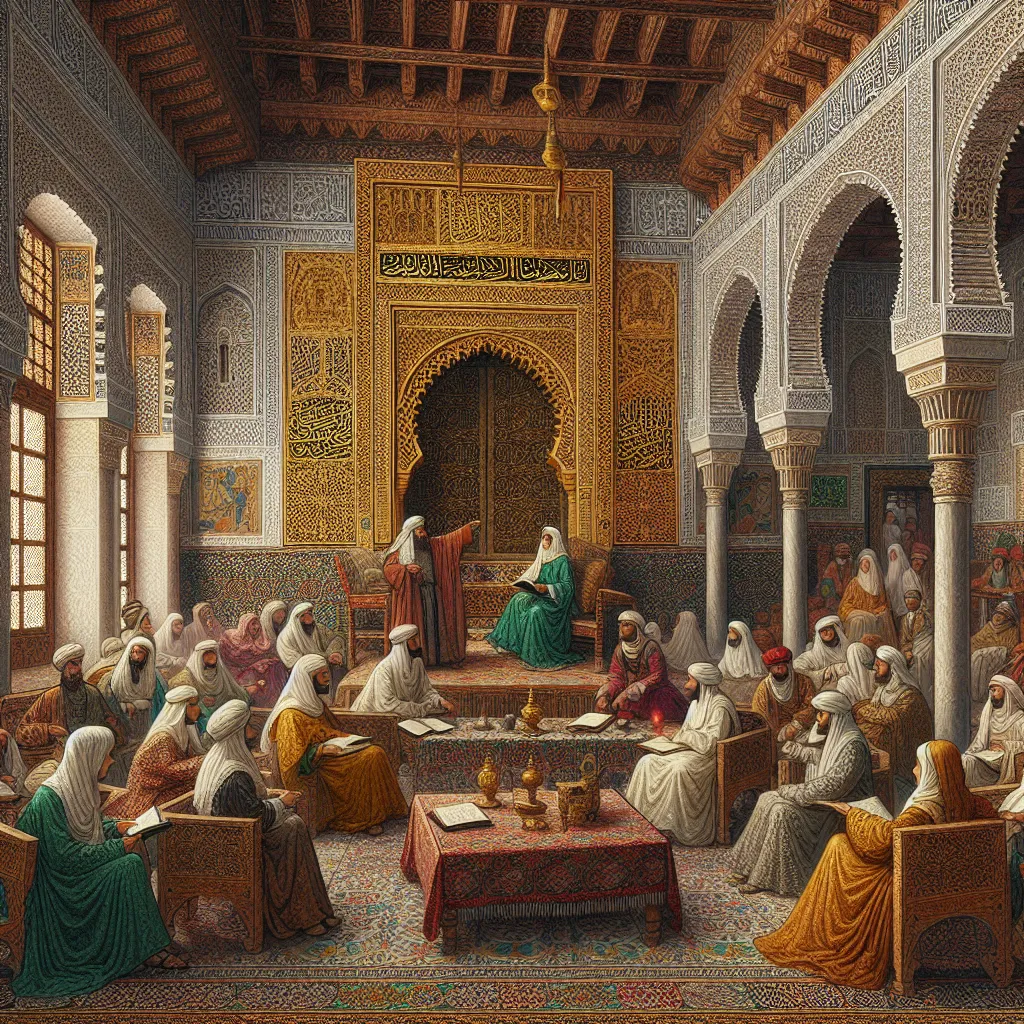
Arabic, estimated to be the fifth most spoken language globally, holds official status across the Middle East and North Africa. Despite its many dialects, Arabic’s role is further magnified as the liturgical language of Islam since it’s the language of the Quran. Muslims worldwide recite the Quran in Arabic daily, even if they don’t grasp every word. This imbues Arabic with significant religious and historical relevance, elevating its status among Muslims.
Historically, Arabic is deemed almost divine. Some Muslims believe it to be the language through which God communicates and that it might be the language of the angels. But if we step away from legends and analyze history and archaeology, what do we find about Arabic’s origins and evolution?
Arabic is a Semitic language, akin to Hebrew and Aramaic. Similarities abound, like the words “salam” in Arabic and “shalom” in Hebrew, both meaning peace. The exact origins of Arabic are tricky to pinpoint as languages continuously evolve. However, a compelling theory is that Arabic traces back to southern Arabia, particularly modern-day Yemen, spreading northward. Recent scholarship flips this theory, suggesting Arabic emerged from the north.
Ancient Arabia wasn’t monolingual; it was a melting pot of languages and scripts. Various regions, such as northern parts of modern-day Saudi Arabia, Syria, and Jordan, showcased early forms of Arabic, often written in different scripts rather than the contemporary Arabic script. This earlier form, or “proto-Arabic,” became more prevalent moving into the 2nd century BCE up to the 4th century CE, mostly in northern Arabia.
Notably, the Nabataeans, who ruled from the 3rd century BCE to the 1st century CE, played a pivotal role in shaping Arabic script. They spoke Arabic but used Aramaic for official writing, gradually adapting their script to write Arabic. By the early 6th century, this evolved script and language form emerged as what we recognize as classical Arabic.
The Quran, considered the direct word of God by Muslims, crucially influenced the Arabic language. Its sacred status necessitated precise pronunciation and understanding, leading to the development of Arabic grammar and script systems. Although early Quranic texts didn’t have vowels, they were added later to safeguard the text’s pronunciation and meaning.
Arabic’s rise paralleled the spread of Islam throughout the Arabian Peninsula and beyond, notably under the Umayyad Caliphate, which established Arabic as the official language of the empire. As Islamic influence grew, so did Arabic’s reach, stretching from the Middle East to North Africa and into southern Spain.
Today, Arabic survives in various dialects, yet classical or “standard” Arabic, known as Fusha, remains the language of the Quran, formal literature, and schooling. It underscores the enduring legacy that began centuries ago, making Arabic not just a means of communication but a carrier of a rich, sacred heritage.
Arabic’s journey from ancient inscriptions to a globally significant language underscores its historical depth and cultural significance. Through time, it has adapted and evolved, yet remains a symbol of unity and identity for millions.