Unveiling the Hidden Influence: How Religion Shapes Global Laws
Religious principles have shaped modern legal systems globally. From Christian influences on Western law to Sharia's impact in Muslim countries, religious values continue to guide landmark decisions and constitutional reforms in family, inheritance, and commercial laws.
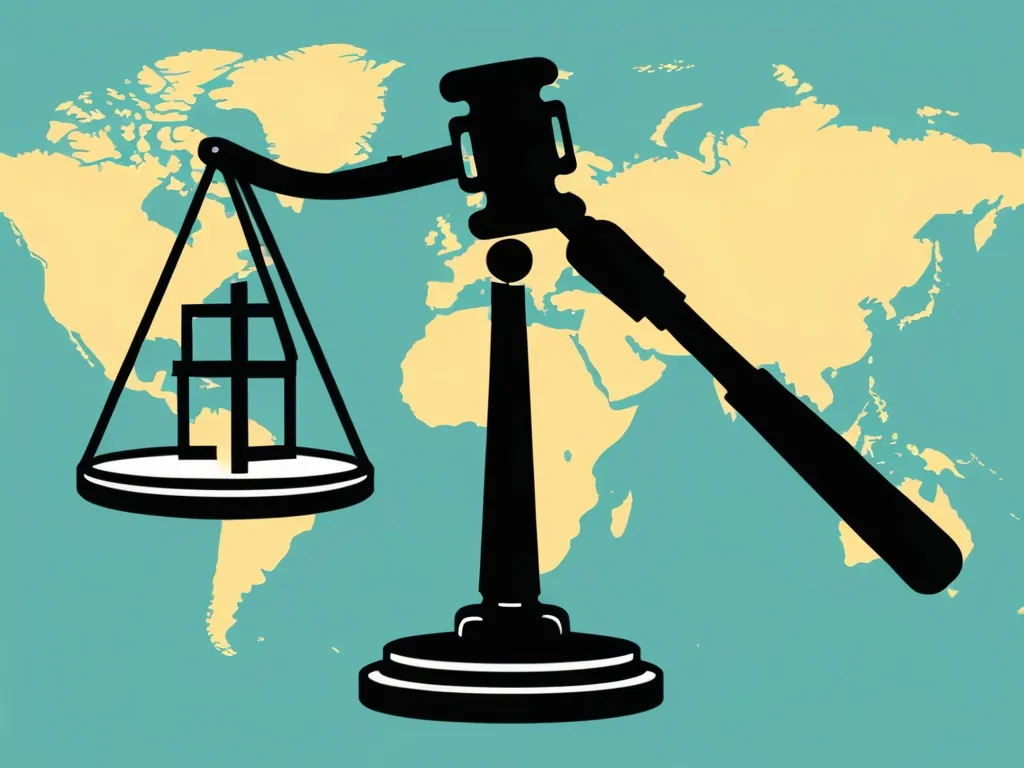
As we navigate the complex web of global legal systems, it’s easy to overlook the silent sculptors that have shaped these frameworks over centuries. Religions, often seen as separate from the secular realm, have had a profound and lasting impact on the laws that govern our societies. Let’s delve into this hidden world and uncover how religious principles have subtly yet significantly influenced modern legal systems.
The Roots of Western Law
Western legal traditions, particularly those in Europe and North America, owe a significant debt to Christian teachings. The concept of justice, for instance, is deeply rooted in Christian ideals. Figures like St. Paul, Augustine of Hippo, and Thomas Aquinas have left indelible marks on legal philosophy. St. Paul’s writings on the relationship between authority and divine will have influenced how societies view the legitimacy of governmental power. Similarly, Thomas Aquinas’s synthesis of Aristotelian philosophy with Christian theology laid the groundwork for many of the principles that underpin modern notions of justice and morality.
The Influence of Sharia Law
On the other side of the globe, Sharia law has been a cornerstone of legal systems in many Muslim-majority countries. Sharia is derived from the Quran and the Hadith, the sayings and actions of Prophet Muhammad. It covers all aspects of life, from family law and inheritance to commercial transactions. In countries like Saudi Arabia, Sudan, and Iran, Sharia is the official law of the land, while in others, it coexists with secular laws. The application of Sharia law is not static; it evolves through interpretations and consensus among scholars, known as ijma, and analogical deductions, or ijtihad. This dynamic nature ensures that Sharia remains relevant and adaptable to changing societal needs.
Religious Rhetoric in Secular Law
Even in secular societies, religious language and imagery can be found in legal texts. The Soviet Union, for example, despite its atheist ideology, employed religious rhetoric in its constitutional acts. The 1924 USSR Constitution used apocalyptic imagery to distinguish between the socialist “kingdom of good” and the capitalist “hell.” This use of religious language was part of a broader strategy to sacralize the state’s power and create a sense of messianic purpose. This phenomenon is not unique to the Soviet Union; many totalitarian regimes have used religious tools to legitimize their authority and control over society.
Landmark Legal Decisions
Religious values have often guided landmark legal decisions, even in countries with strict separation between church and state. In the United States, for instance, the Supreme Court has grappled with cases that involve deep moral and religious questions. The debate over abortion, as seen in cases like Roe v. Wade, has been heavily influenced by religious perspectives on the sanctity of life. Similarly, discussions around capital punishment and euthanasia are often framed within a moral and ethical context that is deeply rooted in religious teachings.
Constitutional Reforms and Religious Debates
Constitutional reforms often stir heated debates that are tinged with religious overtones. In India, for example, the debate over the Uniform Civil Code (UCC) pits secular legal principles against the personal laws of various religious communities. The UCC aims to provide a common legal framework for all citizens, regardless of their religious affiliation, but it faces resistance from communities that see it as an encroachment on their religious rights. This tension highlights the complex interplay between religious values and secular legal systems.
Family Law and Inheritance
In many parts of the world, family law and inheritance are areas where religious law has a significant impact. In Jewish law, for instance, the concept of yibbum (levirate marriage) dictates that a widow must marry her late husband’s brother if she has no children. Similarly, in Islamic law, the distribution of inheritance is governed by strict rules that ensure fairness and justice among heirs. These laws are not merely legal constructs but are deeply embedded in the religious and cultural fabric of the communities they serve.
Commercial Transactions
Even in commercial transactions, religious law can play a crucial role. In Islamic finance, for example, the prohibition on usury (riba) has led to the development of unique financial instruments that comply with Sharia principles. This has resulted in a thriving industry that caters to Muslims around the world, ensuring that their financial dealings align with their religious beliefs.
The Intersection of Moral Authority and Legal Governance
The intersection of moral authority and legal governance is a delicate balance. On one hand, religious principles can provide a moral compass that guides legal decisions and ensures that laws are just and equitable. On the other hand, the imposition of religious values on a diverse society can lead to conflicts and undermine the principles of equality and justice.
As I reflect on this complex relationship, I am reminded of a conversation with a friend who is a lawyer. She shared how, in her practice, she often encounters cases where religious values clash with secular laws. Her approach is not to dismiss either perspective but to find a way to reconcile them, ensuring that justice is served while respecting the moral and religious beliefs of all parties involved.
Conclusion
The influence of religions on global legal systems is a multifaceted and ongoing process. From the historical contributions of Christian thinkers to the contemporary application of Sharia law, religious principles have subtly yet profoundly shaped the laws we live by. As we move forward in an increasingly globalized world, understanding these influences is crucial. It allows us to appreciate the rich tapestry of legal traditions and to navigate the complex moral and ethical landscapes that underpin our societies.
In the end, the silent sculptors of our legal systems are not just legal scholars or politicians but also the religious thinkers and practitioners who have contributed to the moral and ethical frameworks that guide our laws. By recognizing and respecting these contributions, we can build more just, equitable, and harmonious societies where law and religion coexist in a balance that benefits all.