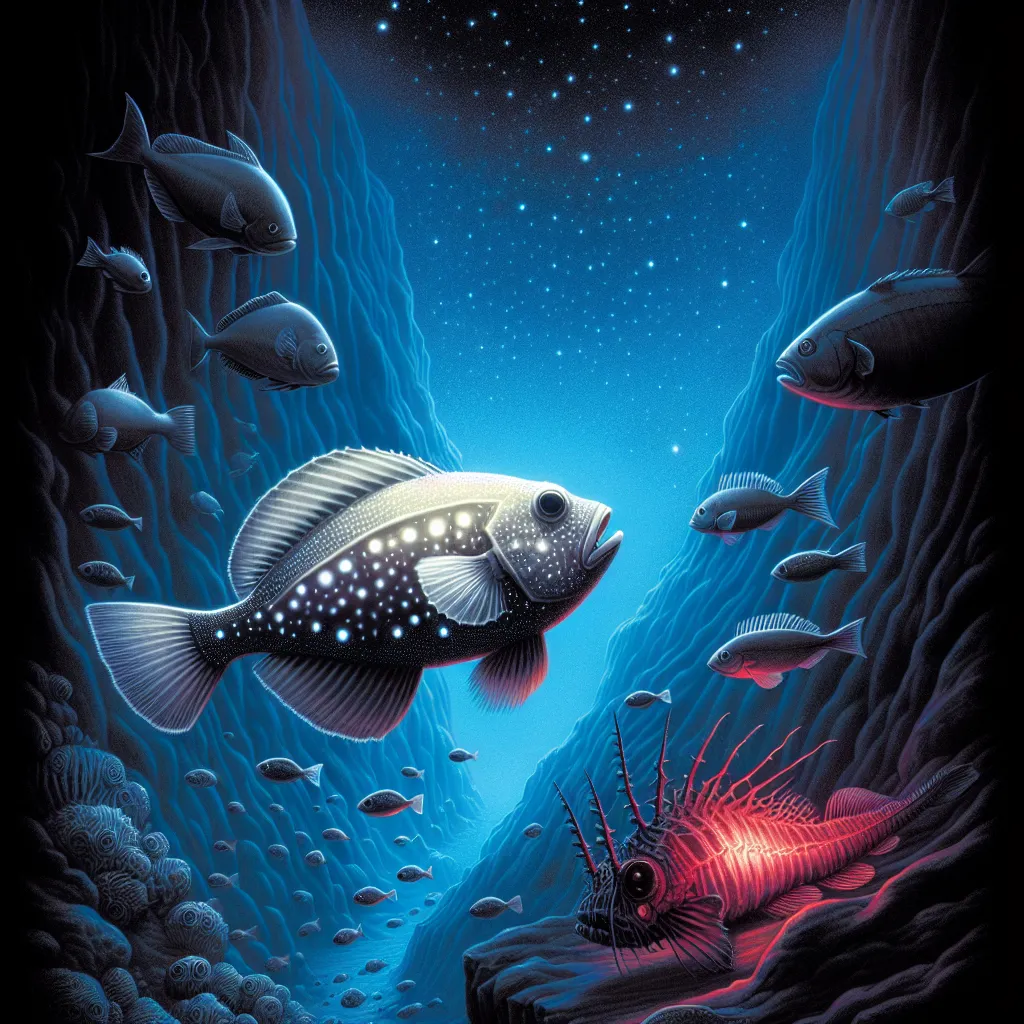
Imagine diving deep beneath the ocean’s surface into a world where faint lights flicker and sharp-toothed grins await you. Welcome to the Twilight Zone. Your mission is simple yet daunting: survive the depths, rise to the surface after sundown to feed, and repeat.
You’re a hatchetfish in this underwater game of survival. You’re equipped with a unique body shape, shiny scales, and glowing spots on your belly. These tools might just give you the edge you need.
Nightfall is your signal to start the upward journey. Your swim bladder is your secret weapon for controlling buoyancy. As you fill it up, you slowly ascend, becoming less dense. Though you’re not a fast swimmer, your narrow body makes you surprisingly agile, which is crucial because danger lurks everywhere.
A fangtooth swims beneath you. Known for having the largest tooth-to-body ratio, this predator is a master of ocean camouflage with its ultra-black skin. Thankfully, your bioluminescent organs on your belly adapt to match the faint surface light, making you nearly invisible from below.
A distant bright spot catches your attention. Cautiously, you approach it, only to realize it’s the lure of an anglerfish, just in time to dart away. Another close call.
Next, you face a dragonfish, a unique predator that emits red light, the only color most deep-sea creatures can’t see. Its red light acts as a headlight, spotting prey invisible to others. But your mirror-like scales scatter light, keeping you hidden. Close call number three.
After navigating these dangers, you finally reach the Photic Zone. Here, the ocean teems with resources. Your sensitive eyes feast on crustaceans and zooplankton. The food web here is vibrant, with phytoplankton converting sunlight into energy and serving as the base for countless marine diets.
Your journey plays a vital role in the ocean’s ecosystem, part of the biological carbon pump that locks away atmospheric carbon dioxide, helping to curb climate change. As sunrise nears, you retreat back to the Twilight Zone, ready to repeat this life-saving journey every night.