What Secrets Did East Berlin's Midnight Builders Hide?
Decades of Division and a Night of Joy: The Berlin Wall Saga
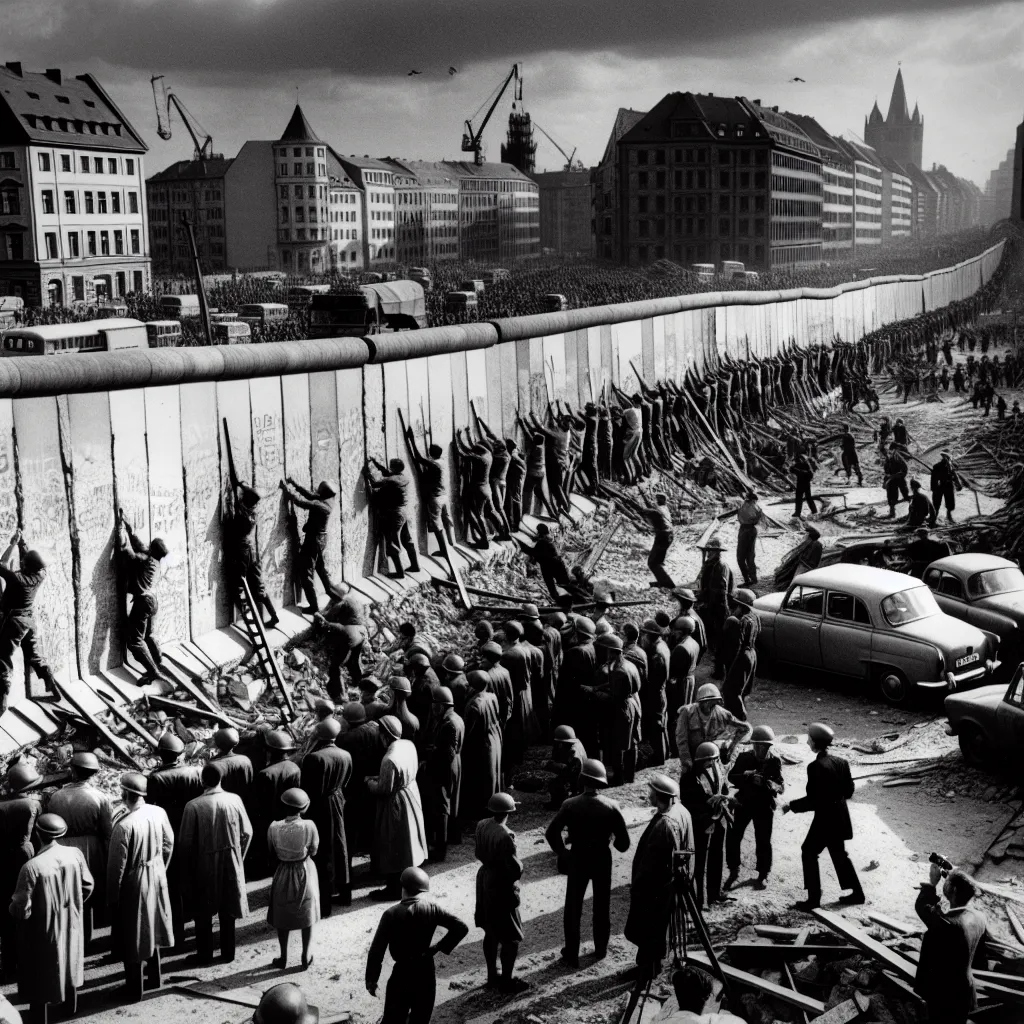
In the early hours of August 13, 1961, East German construction workers, backed by soldiers and police, began tearing up streets and putting up barriers all over Berlin. This marked the start of the infamous Berlin Wall. Over the next decade, the wall divided neighborhoods, families, and the world.
To understand how we got here, we need to go back to World War II. America, Britain, and France teamed up with the Soviet Union to defeat Nazi Germany. After the war, each of the victorious nations occupied a part of Germany. This division was supposed to be temporary, but tensions quickly rose. Western powers promoted market economies, while the Soviet Union wanted to create obedient Communist nations, including a weaker Germany. This split resulted in the Federal Republic of Germany in the West and the German Democratic Republic in the East, separated by the Iron Curtain.
Berlin was a special case. Even though it was deep within East German territory, the city was jointly administered by the Allies. This meant that it was possible to move from East to West Berlin easily. All East Germans had to do was walk or take public transport into West Berlin and then move on to West Germany or beyond. This freedom was a problem for East German leaders. They portrayed West Germany as a continuation of the Nazi regime and needed to stop the mass exodus to the West.
By 1961, around 3.5 million East Germans had left, mostly young professionals. To stop this, East Germany closed the border and built the Berlin Wall. The initial barrier was barbed wire and mesh fencing, but it quickly became a 106-kilometer long concrete barricade topped with smooth pipes, spike strips, guard dogs, and even landmines. Despite the danger, nearly 5,000 people managed to escape from East Germany between 1961 and 1989 through tunnels, swam canals, or even crashed tanks through the wall. However, over 138 people died trying to escape, some in full view of powerless West Germans.
The wall stabilized East Germany’s economy by stopping its workforce from leaving but tarnished its image. It became a global symbol of Communist repression. The Basic Treaty of 1972 recognized East Germany, although West Germany hoped for reunification. By the end of the 1980s, mass protests for free travel and democracy emerged. On November 9, 1989, East Germany tried to ease tensions by making travel permits easier to get, causing thousands of East Berliners to flood the border, forcing guards to open the gates.
People from both sides celebrated atop the wall and began demolishing it. The Berlin Wall came down, and after nearly 40 years, Germany was officially reunified in October 1990. The Soviet Union fell soon after. Today, parts of the wall stand as a reminder that any barriers to freedom can be broken down.