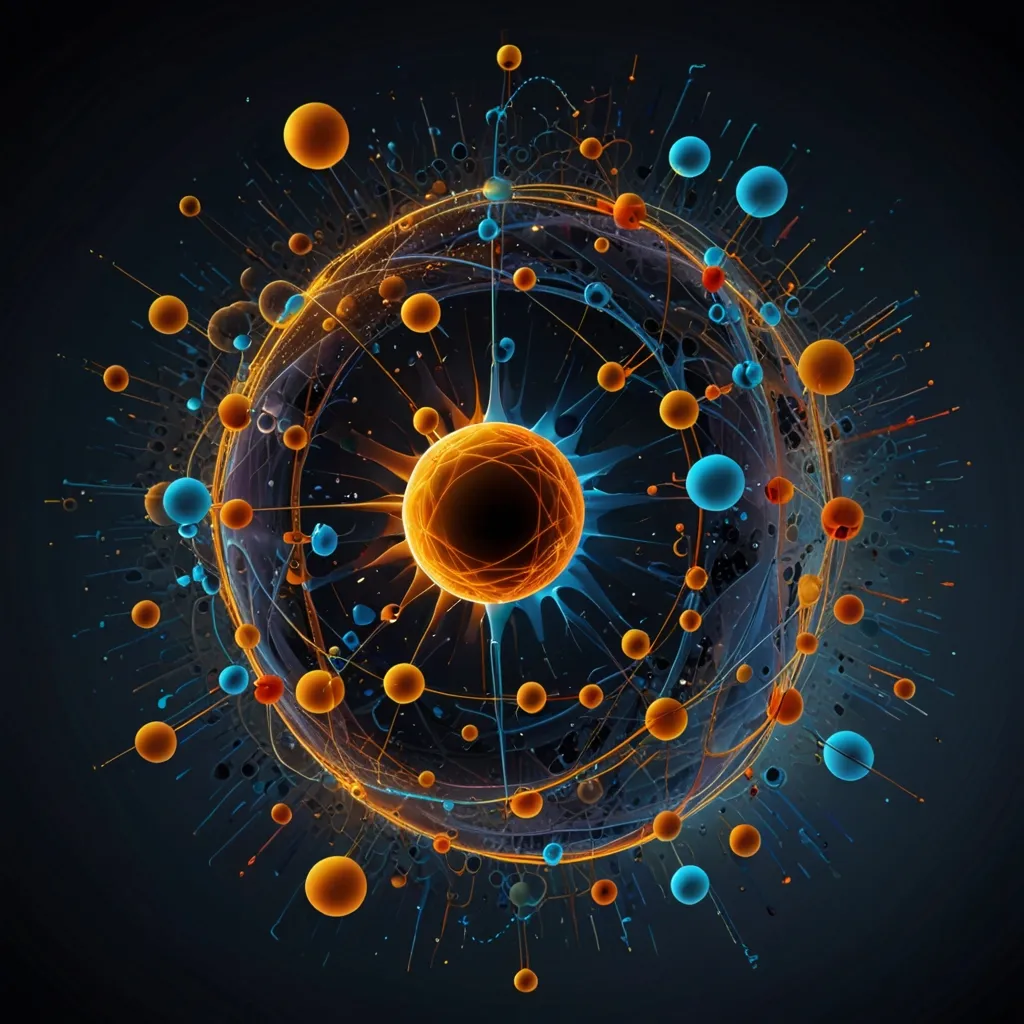
The core force that binds protons and neutrons together in the nucleus of larger atoms is known as the strong nuclear force. It’s crucial to differentiate this from the strong force that binds quarks together—it’s all about different contexts. Essentially, the strong nuclear force is a form of potential energy and contributes to the mass of an atom.
In simpler terms, the strong force involves gluons to hold charged quarks inside protons or neutrons (collectively known as nucleons). However, when a quark is stretched far enough out of a nucleon, the energy created from the stretch can form a new quark-antiquark pair. This pair results in a short-lived particle called a meson. A meson has a longer range than a gluon, approximately the diameter of a nucleus.
What’s fascinating is how these mesons act as force transmitters between nucleons inside the nucleus—this is essentially what makes up the strong nuclear force. This force is integral in maintaining the stability of the atomic nucleus, ensuring that atoms don’t just fall apart.