What Hidden Secrets Does Leonardo’s Vitruvian Man Reveal About Human Potential?
A Renaissance Sketch Bridging Geometry, Philosophy, and the Essence of Human Potential
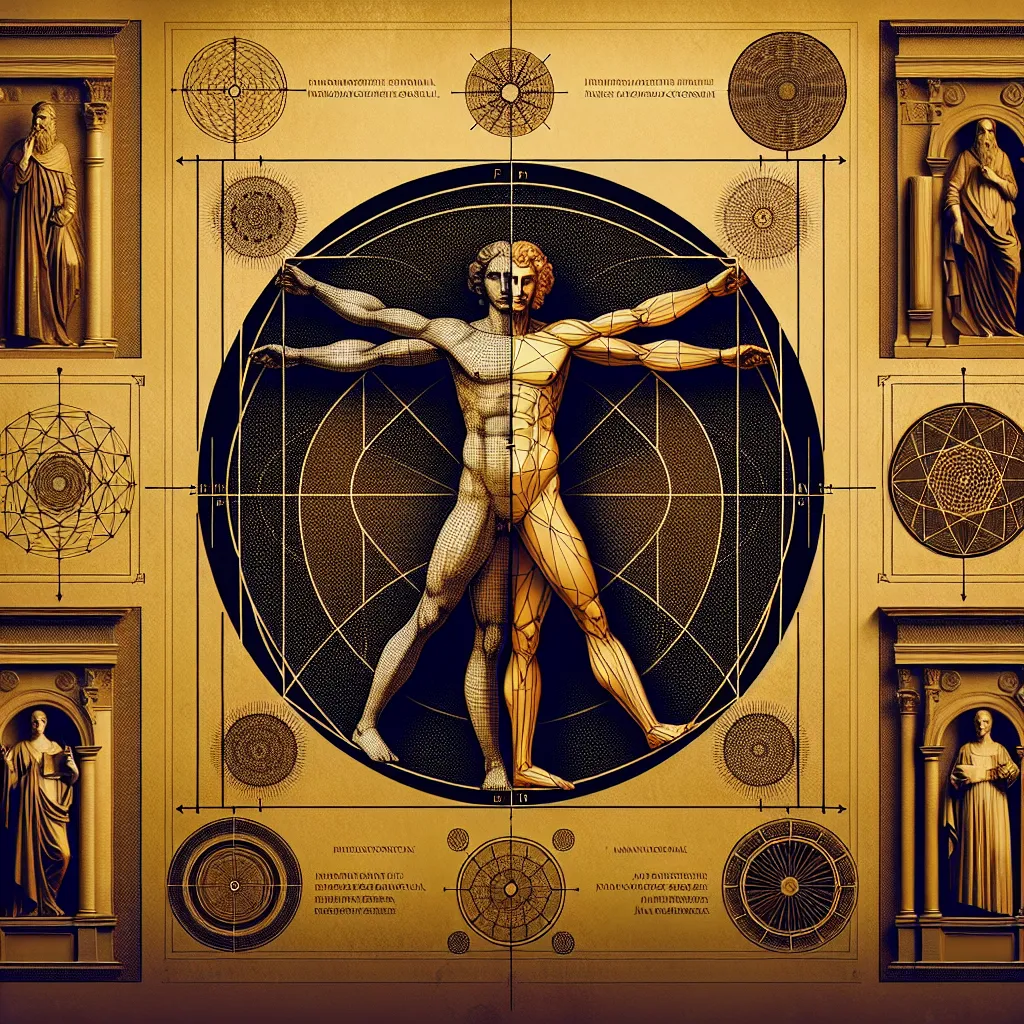
The Vitruvian Man, a famed sketch by Leonardo da Vinci, stands as an emblem of the Renaissance. It might seem like a simple pen and ink drawing, but it’s much more profound.
The sketch connects deeply with the mathematical puzzle of “squaring a circle,” an idea from ancient times that reemerged during the Renaissance. While it’s impossible to solve this problem due to the nature of pi, Leonardo found a metaphorical solution. Drawing influence from Vitruvius, a Roman architect, Leonardo positioned a man inside both a circle and a square. Vitruvius believed the human navel was the center of the body. By placing a compass at the navel, a circle could be drawn perfectly around the body. Moreover, he noted that arm span and height were almost equal, fitting the body neatly within a square.
But there was more than just math on Leonardo’s mind. At the time, Neoplatonism was an influential intellectual movement in Italy. This philosophy, evolving from Plato and Aristotle, spoke of “The Great Chain of Being,” a hierarchical structure of the universe. Initially, humans were placed in the middle of this chain, bridging the mortal and immortal realms.
However, Pico Della Mirandola, a Neoplatonist, presented a different perspective. He proposed that humans aren’t fixed in this chain but have the potential to occupy any position. Pico suggested that God created humans with the flexibility to understand and adapt to the complexities of the universe. According to him, humans can choose to behave like animals or ascend to divine heights.
Leonardo’s Vitruvian Man captures this idea. The varying positions of the man within the drawing symbolize the human ability to adapt and exist within all elements of the universe. It’s a blend of geometry, philosophy, religion, and art, making it an iconic representation of the Renaissance.
This singular sketch, bringing together diverse strands of thought and skill, encapsulates the era’s grandeur, securing its place as a timeless symbol of human potential and ingenuity.