What Happens When You Fold a Piece of Paper 45 Times?
The Astounding Journey from Bible Paper to Space in 48 Folds
Have you ever wondered how many times you can fold a piece of paper? Let’s dive into this fascinating question, especially when dealing with an incredibly thin piece of paper like the kind used to print the Bible.
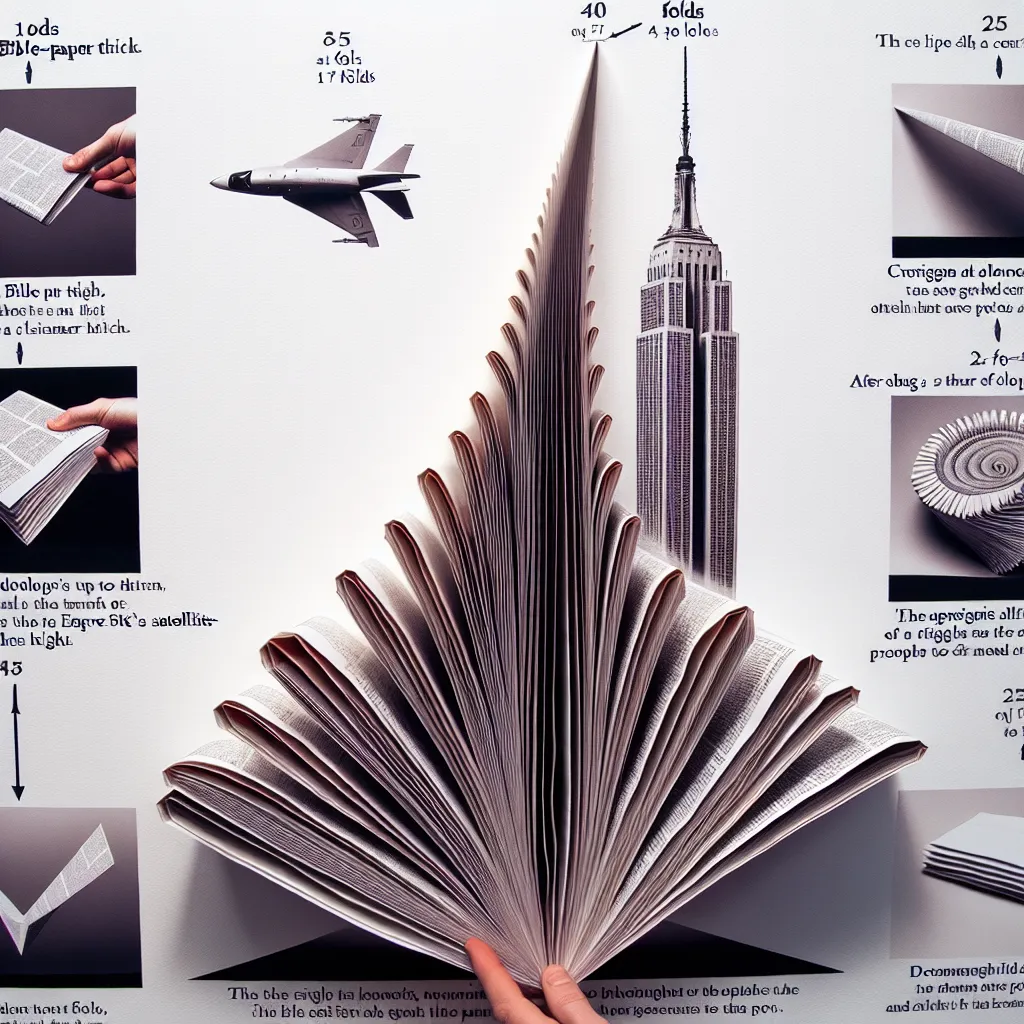
Picture this: You’ve got a sheet of paper that’s only one-thousandth of a centimeter thick, and it’s as large as a newspaper. How many times can you fold it in half? More interestingly, what if you could fold it 30 times? How thick would it get?
After the first fold, the paper’s thickness doubles to two-thousandths of a centimeter. Fold it again, and it quadruples to four-thousandths of a centimeter. Each time you fold, the thickness doubles. So, after 10 folds, we’re at just over a centimeter thick. Seems pretty straightforward, right? But then things get wild.
After 17 folds, the paper is now 131 centimeters thick—just over four feet. By the time you fold it 25 times, you’ve got a thickness of over 1,100 feet, almost as tall as the Empire State Building.
Let’s take it even further. At 30 folds, our paper would stretch to about 6.5 miles, matching the cruising altitude of a jet. Hit 40 folds, and you’re looking at nearly 7,000 miles, which is the average altitude of a GPS satellite.
If you keep folding, at around 48 folds, the thickness would surmount over one million miles. Keep in mind, the distance from Earth to Moon is less than 250,000 miles. So, theoretically, with 45 folds, your paper reaches the Moon; fold it once more, and it comes back down to Earth.
What this little exercise highlights is the concept of exponential growth. Just by folding a piece of paper, you can achieve incredible distances very quickly. It’s a neat reminder of just how powerful doubling can be.