In the fascinating world of astrophysics, there’s a specific limit to how much mass a white dwarf star can sustain before undergoing a significant transformation. This limit, known as the Chandrasekhar limit, is named after the Indian-American physicist Subrahmanyan Chandrasekhar. He discovered that a white dwarf star could not possess more than about 1.4 times the mass of our Sun without collapsing.
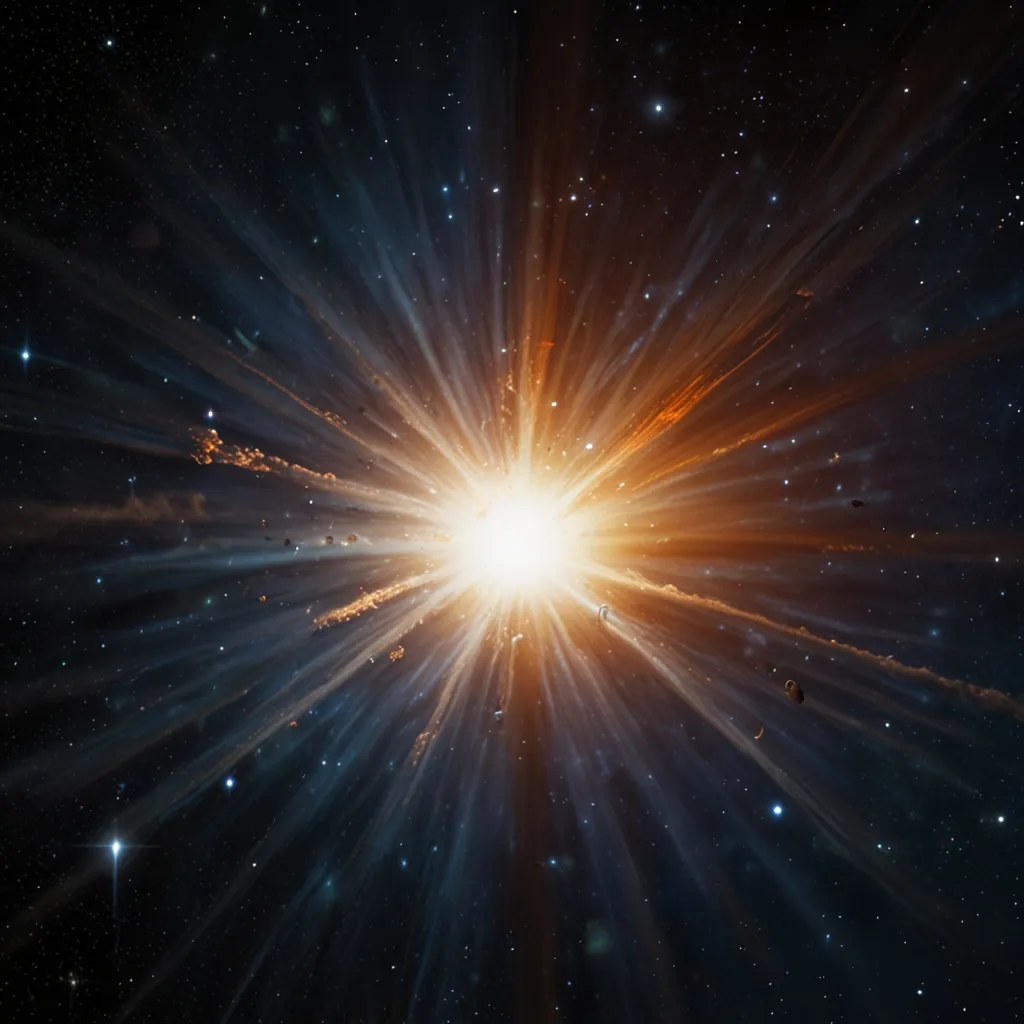
When a white dwarf surpasses this limit, the core temperatures escalate dramatically, soaring past 5 billion degrees Celsius. At these intense temperatures, gamma rays are produced, which have enough energy to break iron nuclei into helium nuclei, also known as alpha particles. This reaction further increases the temperature to an astonishing 100 billion degrees Celsius.
Under such extreme conditions, electrons begin to combine with protons in a process termed electron capture, resulting in the formation of neutrons and a release of neutrinos. By this point, the electrons are captured by the nucleus, forming a dense core of neutrons. The end result is a transformation from a white dwarf into a neutron star.
Neutron stars are incredibly dense – much denser than white dwarfs. While a white dwarf could be roughly the size of the Earth, a neutron star shrinks down to a mere 10 to 20 kilometers wide. This immense density and compact size make neutron stars some of the most fascinating objects in the universe.