science

Did Light Waves or Particles Shine Brighter in the Battle of the Geniuses?

The Story of Light: A Journey from Ether Waves to Quantum Photons

Did Light Waves or Particles Shine Brighter in the Battle of the Geniuses?

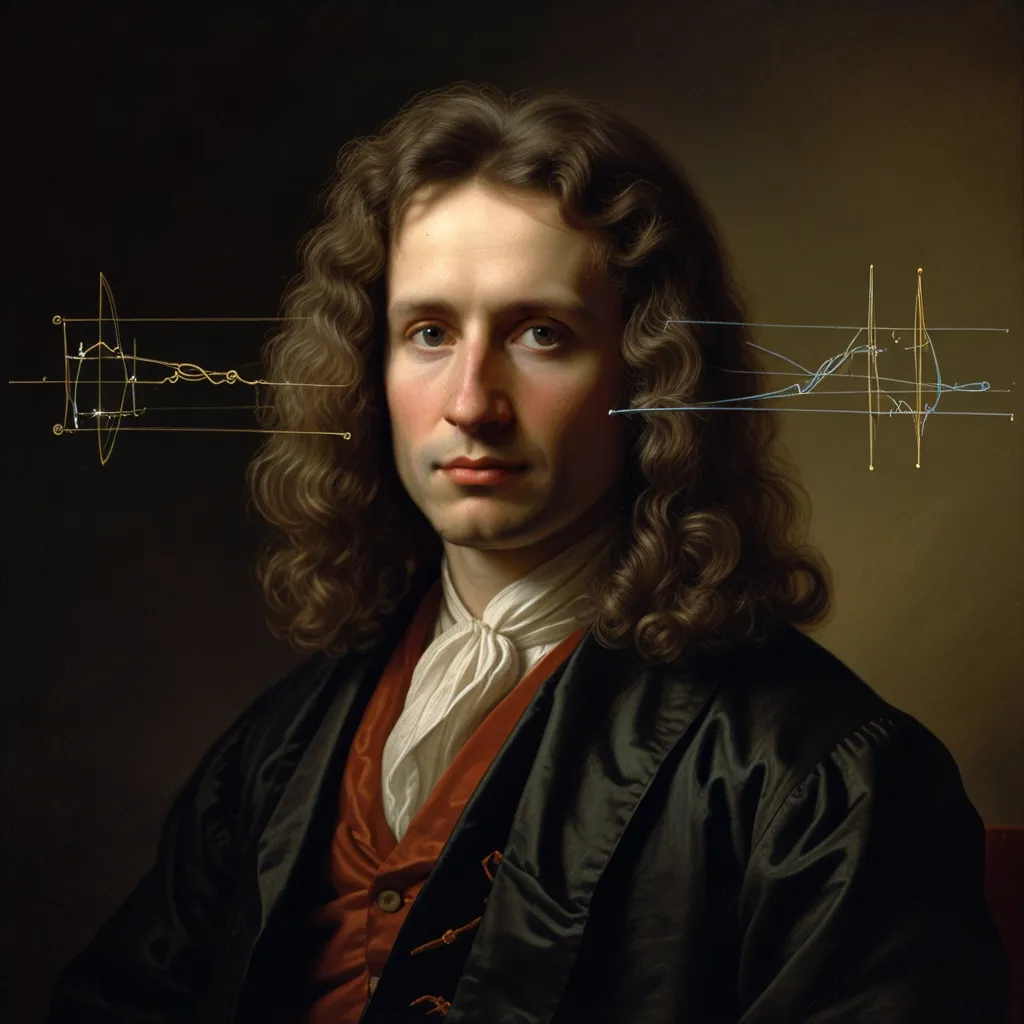
In the 17th century, scientific minds were buzzing with debates about the nature of light. Dutch astronomer Christian Huygens put forth the idea that light was a wave, vibrating through some kind of ether. Back then, it was assumed that all waves needed a medium to travel through, hence the imagined ether.

Around the same time, Isaac Newton had a different take. He proposed that light was made up of tiny particles, which he called corpuscles, traveling at a finite speed. For a while, these competing theories coexisted, each having its own strong proponents.

A significant shift came in 1801 when Thomas Young conducted his famous double-slit experiments. By splitting a beam of light and making it pass through two slits, he observed an intriguing pattern of light and dark bands. This interference pattern suggested that light behaved like a wave, as the phenomenon couldn’t be explained if light were just particles.

Fast forward about a century, and Einstein entered the scene with groundbreaking insights. Despite the wave-like behavior observed in Young’s experiments, Einstein demonstrated that light also comes in tiny packets of energy, which we now call photons. This discovery bridged the gap between the wave and particle theories, showing that light has a dual nature, acting both as a wave and as discrete energy packets.

These landmark discoveries over the centuries have deeply enriched our understanding of light, revealing its complex, dual character in the world of physics.



Similar Posts
Blog Image
Are We Living in One of Many Parallel Universes Right Now?

A Voyage Through the Multiverse: Quantum Mechanics' Many-Worlds Interpretation

Blog Image
Why Do Our Batteries Live and Die?

A Journey Through Time: From Frogs to Future Quantum Batteries

Blog Image
Nature's Blueprint: Incredible Buildings Inspired by Biological Marvels

Biomimetic architecture draws inspiration from nature to create sustainable buildings. Examples include Zimbabwe's Eastgate Centre (termite mounds), Beijing's Bird's Nest (bird nests), and Sydney's One Central Park (vertical gardens). These designs mimic natural structures and processes, resulting in energy-efficient, environmentally friendly buildings that enhance human well-being while reducing environmental impact.

Blog Image
Is Choosing Between Brilliance and Survival Humanity's Ultimate Dilemma?

The Eternal Dilemma: Choosing Between Creative Extinction and Survival

Blog Image
5 Ancient Medical Practices That Shaped Modern Medicine: From Acupuncture to Hippocrates

Discover how 5 ancient medical practices, from acupuncture to willow bark remedies, continue to shape modern healthcare. Learn the science behind these time-tested healing methods. #MedicalHistory #Healthcare

Blog Image
Could We Really Be Running Out of Oil, Or Is It Just a Myth?

A Century of Oil: Abundance, Advancements, and the Environmental Cost