Did Isaac Newton's Apple Hide the Secrets of Dark Matter?
Newton's Revolutionary Legacy and the Quest to Unveil Cosmological Mysteries
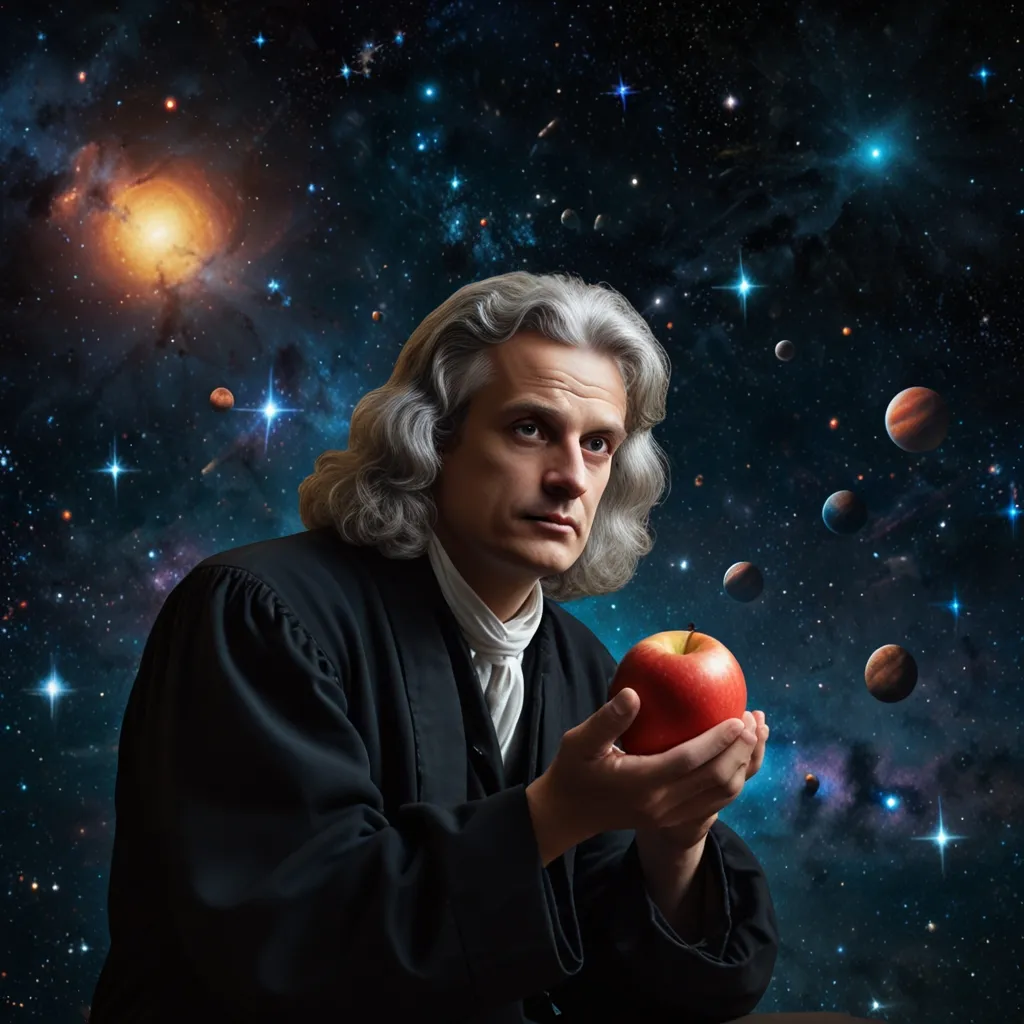
Isaac Newton remains one of the most influential scientists in history. He revolutionized our understanding of gravity, connecting the force that pulls an apple to the ground with the force governing the orbits of planets. For centuries, Newton’s equations were considered flawless. However, the odd motion of Mercury puzzled scientists as its orbit’s precession didn’t match Newton’s predictions. This inconsistency led French mathematician Urbain Le Verrier to hypothesize the existence of an invisible planet, Vulcan, between Mercury and the Sun. But as years passed, no such planet was found.
In the 1920s, Einstein’s theory of general relativity provided a more precise model of gravity, successfully explaining Mercury’s peculiar orbit as an effect of space-time curvature. This correction highlighted a flaw in Newton’s laws, bringing into question our assumptions about dark matter. Fast forward to the 1970s when Vera Rubin discovered that stars on the outer edges of galaxies moved as quickly as those nearer the center, contradicting the expected behavior based on Newton’s and Einstein’s laws of gravity.
This anomaly suggested the existence of dark matter, an unseen substance that made up about 85% of the universe’s mass. Despite extensive research, no dark matter particle has been definitively detected, leading some scientists to propose alternative explanations. Israeli physicist Mordehai Milgrom, in 1983, introduced Modified Newtonian Dynamics (MOND), suggesting that a tweak in Newtonian mechanics could account for galactic movements without invoking dark matter.
MOND implied that within galaxies, gravity behaves differently than expected at larger distances. While this theory fits the motion of stars within galaxies perfectly, it struggles with explaining the behavior of galaxy clusters. The Bullet Cluster, for instance, remains a strong argument for dark matter, supported by gravitational lensing showing mass where ordinary matter is scarcely visible.
Moreover, the cosmic microwave background radiation – the afterglow of the Big Bang – suggests that ordinary matter constitutes only 5% of the universe’s total matter. To achieve a flat universe, as indicated by observations, an extra 25% of matter is required, most likely in the form of dark matter.
Thus, while MOND provides compelling arguments for galactic dynamics, it falls short on larger scales. It’s increasingly clear that while modifying gravity helps explain certain phenomena, dark matter still plays an essential role in our universe’s grand structure. The scientific community continues to explore both avenues, keeping alive the hope of one day uncovering the true nature of dark matter.
In essence, while our theories evolve and adapt, the quest for understanding the cosmos remains a thrilling endeavor, suggesting that the answer might lie in a combination of modified gravity and the elusive dark matter particles. As research progresses, we may find ourselves on the brink of groundbreaking discoveries in the near future.