Did Hiccups Start as a Frog's Curse or Just an Evolutionary Burp?
Hiccup Mysteries: From Ancient Fish Lung Transitions to Baffled Doctors and Home Remedies
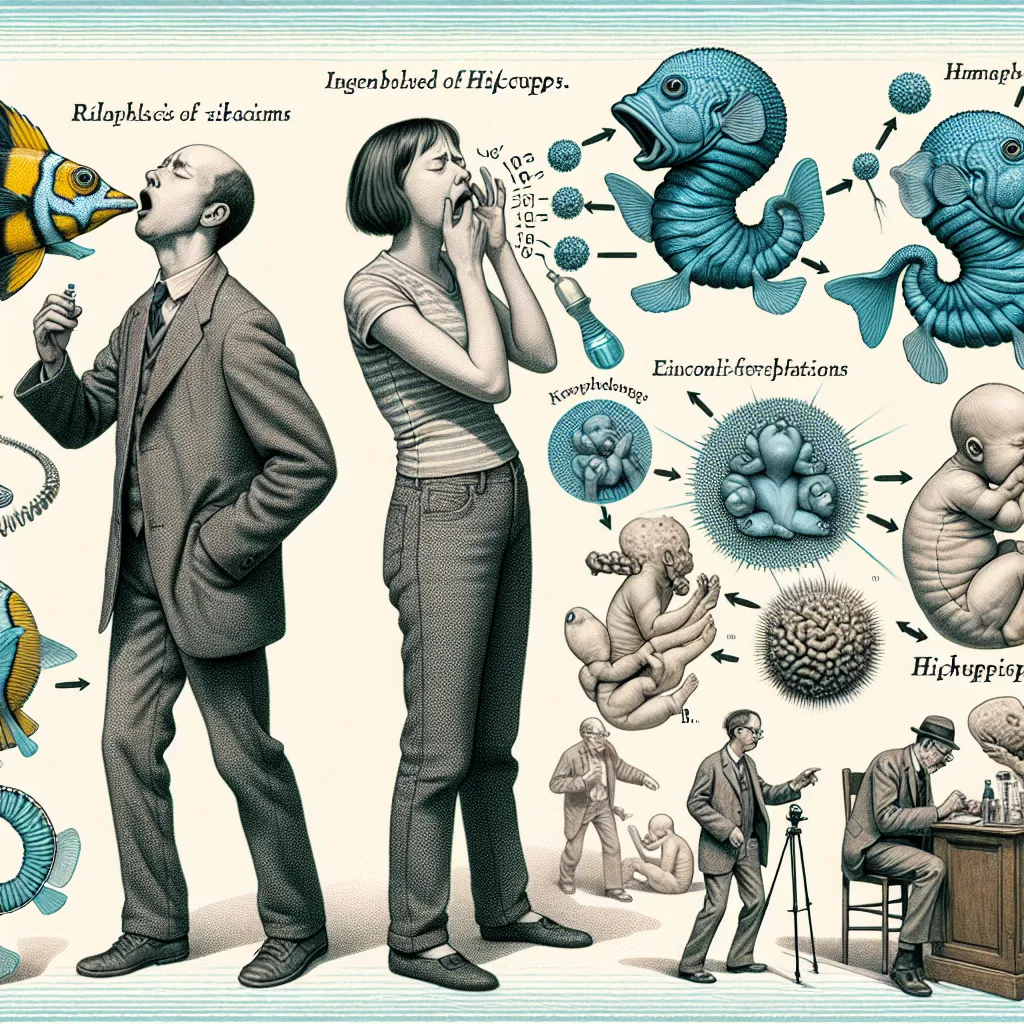
Charles Osborne’s hiccup journey began in 1922, when a hog fell on him. He hiccupped for a staggering 68 years, securing a spot in the Guinness World Records for the longest hiccup streak. In contrast, Jennifer Mee, a teen from Florida, experienced hiccups 50 times per minute for over four weeks in 2007.
So, what triggers these pesky hiccups? Doctors often link them to stimuli that stretch the stomach, such as swallowing air or hurriedly eating or drinking. They can also be tied to intense emotions or reactions, like laughter, sobbing, anxiety, and excitement.
When you hiccup, it’s because of an involuntary spasm or contraction of the diaphragm, the muscle beneath our lungs that helps us breathe. This spasm is quickly followed by the sudden closure of the vocal cords and the glottis, the opening between them. This movement causes a sudden intake of air, but the vocal cords block it, creating the familiar “hic” sound.
Interestingly, hiccups don’t seem to have any clear purpose. They don’t offer any medical or physiological benefits. Their seemingly pointless nature poses a challenge for evolutionary biologists. Do they serve a hidden function yet to be discovered, or are they just evolutionary remnants?
One theory suggests that hiccups originated millions of years ago, way before humans appeared. Early fish, living in low-oxygen water, developed lungs to breathe the abundant oxygen in the air. As these fish transitioned to land animals, they moved from using gills to lungs. Frogs exemplify this rapid change today, shifting from gill-breathing tadpoles to air-breathing adults. This idea proposes that hiccups might be a leftover from this transition – an inhalation to move water over gills followed by a glottis closure to stop water from entering the lungs. Some evidence indicates that the neural pattern creating hiccups is similar to amphibian respiration.
Another group of scientists argues that hiccups persist because they offer an advantage, especially since true hiccups are only found in mammals, not in birds, lizards, turtles, or other air-breathing animals. Hiccups appear in human babies long before birth and are more common in infants. These scientists believe that the ancient hiccup reflex could have been adapted by mammals to help expel air from the stomach, acting as a sophisticated burp. The diaphragm’s expansion would release air from the stomach, while the glottis closure would prevent milk from entering the lungs.
When hiccups persist, many of us turn to home remedies: sipping cold water, holding our breath, eating a spoonful of honey or peanut butter, breathing into a paper bag, or experiencing a sudden scare. Sadly, scientists haven’t confirmed that any remedy consistently works better than the others. But one thing is clear – some methods do definitely fall flat.