Did a High School Dropout Really Change the Way We See Reality?
Einstein's Genius: From Rejected Student to Revolutionary Physicist Redefining Reality
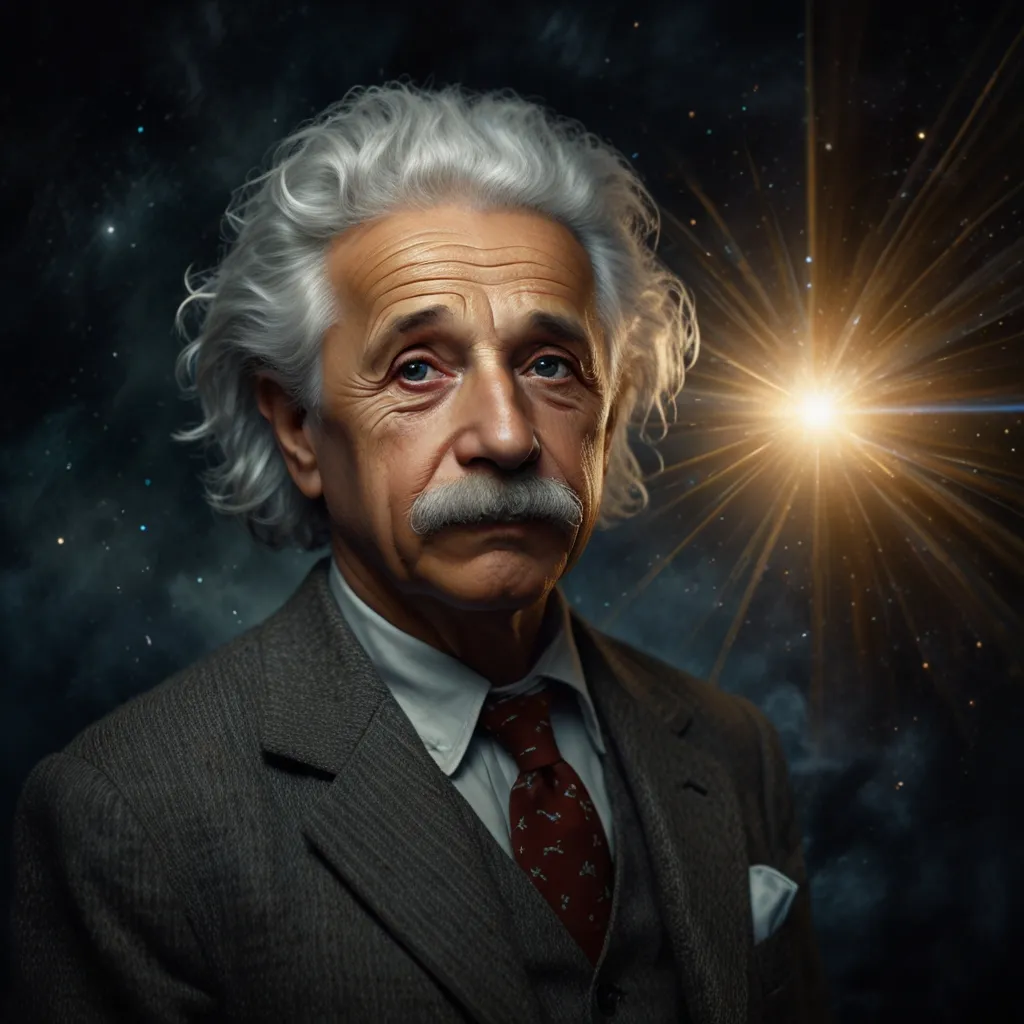
In 1894, a high school teacher advised one of his talented but unhappy students to leave school. The teenager took the advice and never returned. His attempts to enroll in a prestigious university failed, and later, no university would hire him as a professor. He ended up with a lowly clerk job at a patent office. This teenager, ignored and rejected by many, would later revolutionize physics and change the way we view reality itself. In 1999, Time magazine named him Man of the Century, and today, his name is synonymous with “genius.” Of course, I’m talking about Albert Einstein.
Einstein’s groundbreaking journey in physics began with a simple thought experiment he conjured up as a teenager before graduating from high school. His curiosity led him to form the theory of special relativity, which was remarkably revolutionary for its time.
Back in 1801, Thomas Young’s double-slit experiment had shown that light behaved like a wave. This convinced the scientific community that light needed a medium to travel through, much like water waves require an ocean. However, light was known to travel through the vacuum of space, so scientists proposed the existence of a medium called the “luminiferous ether” that supposedly permeated the cosmos.
In 1887, Albert Michelson and Edward Morley conducted an experiment to test the existence of the ether. They designed a device to measure the speed of light in different directions, expecting different speeds due to the Earth’s motion through the ether. Surprisingly, their experiment showed no difference in light speed, challenging the ether theory and leaving scientists puzzled.
At this point, Albert Einstein entered the scene. He knew about James Clerk Maxwell’s work, which described light as an electromagnetic wave traveling at a constant speed of around 186,000 miles per second. As a sixteen-year-old, Einstein imagined himself chasing a beam of light at its speed. He realized that if he could catch up, he would see a stationary wave of light, which contradicted Maxwell’s equations.
Einstein proposed two key postulates. The first was that the laws of physics are the same for all non-accelerating observers, a concept already known as classical relativity. The revolutionary second postulate stated that the speed of light in a vacuum is constant for all observers, regardless of their motion. This idea, although bold, helped reconcile Maxwell’s equations with relativity.
Einstein initially struggled with a significant problem in his theory. If a beam of light moved alongside a train, observers on the train and on the ground would measure different light speeds, which contradicted his first postulate. Ultimately, he realized that time itself must differ for observers in relative motion—a breakthrough that laid the foundation of special relativity.
This insight overturned centuries of classical physics and eliminated the need for the ether. Einstein’s realization that time is relative led to other profound implications: objects moving at high speeds appear shorter and have increased mass, culminating in the famous equation E=mc², stating the equivalence of mass and energy.
Some argue that much of the theoretical work for special relativity existed before Einstein. Indeed, time dilation and simultaneity concepts had been explored by others like Lorentz and Poincare. However, Einstein deserves credit for integrating these pieces into a coherent new theoretical framework. He boldly discarded the ether theory and fundamentally redefined our understanding of time and reality.
Einstein’s journey from a rejected student to a scientific legend teaches us that persistence and bold thinking can change the world. His ability to see beyond the accepted norms and offer a new perspective has left an indelible mark on science and our understanding of the universe.