Can You Unlock the Secrets of the Universe with Feynman Diagrams?
Universe's Dance: Forces, Particles, and the Beauty of Feynman Diagrams
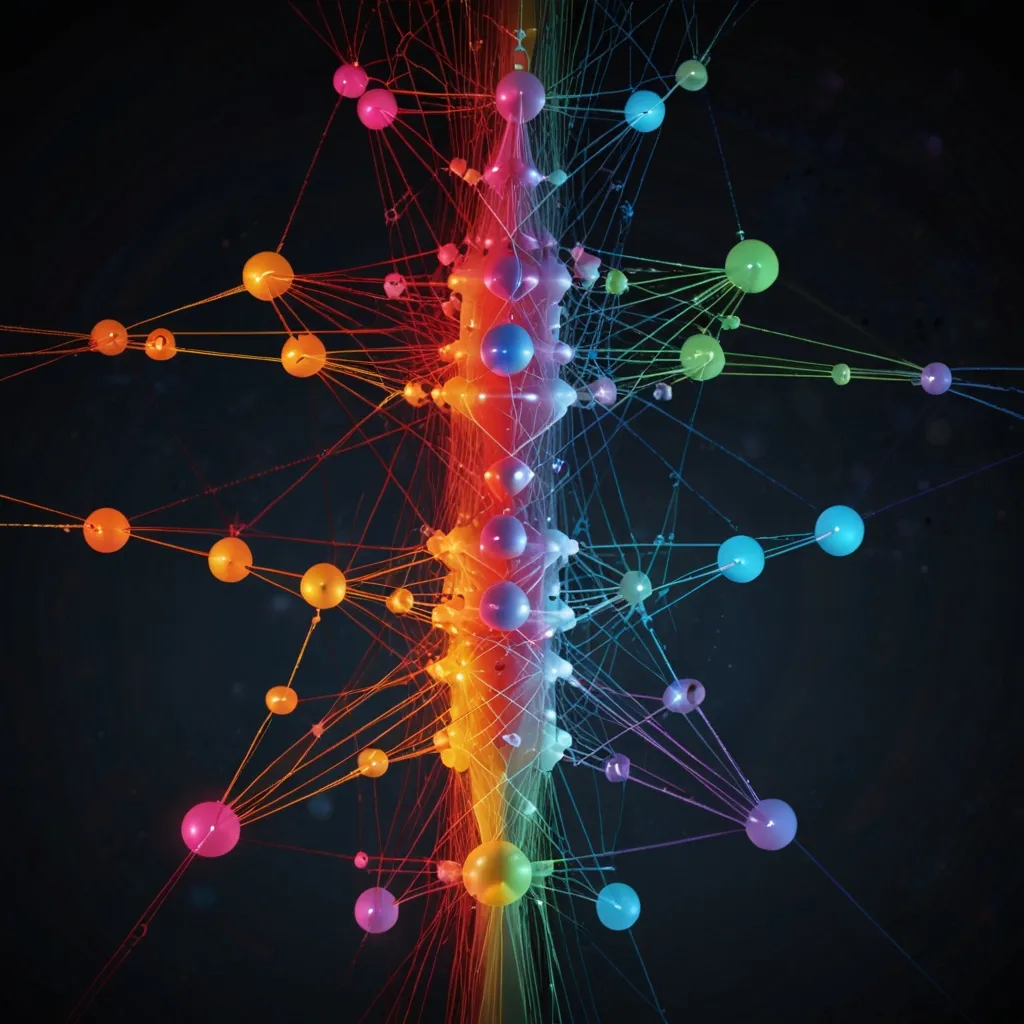
The universe operates under four fundamental forces: strong, weak, electromagnetic, and gravitational. Quantum descriptions exist for all but gravity, whose insignificance at the quantum level allows physicists to often overlook it in calculations. Over nearly a century of scientific progress, we have developed precise quantum field theories for the other three forces.
These forces interact through particles: photons carry the electromagnetic force, W and Z bosons manage the weak force, and gluons handle the strong force. In quantum field theory, these force carriers are represented by fields—an electron field mediated by a photon field, for example, results in the repulsion between electrons. By adding and interacting these fields, we can describe all fundamental particles and interactions.
Richard Feynman simplified this complex landscape with Feynman diagrams. These diagrams visually represent particle interactions and make it easier to grasp the underlying quantum mechanics. For instance, they illustrate how particles like electrons and quarks interact through different forces, such as the photon-electron interactions in electromagnetism.
In quantum electrodynamics (QED), a basic Feynman diagram might show an electron absorbing or emitting a photon, leading to energy changes or orbital transitions. Another diagram could depict how two electrons repel each other by exchanging virtual photons, a process known as Møller scattering.
When it comes to the weak force, Feynman diagrams become a bit more intricate. This force can change the “flavor” of particles, enabling transformations like a neutron decaying into a proton, electron, and antineutrino—a crucial process for the existence of atoms and life. The Z boson, another weak force mediator, can even interact with electrically neutral particles, setting it apart from the photon.
The strong force, while mathematically complex, mainly affects quarks and gluons. One of its key roles is holding protons and neutrons together within an atom’s nucleus through gluon exchange and meson production. These interactions ensure the stability of the atomic nucleus.
One of the crowning achievements in modern particle physics is the Higgs boson’s discovery, facilitated by gluon fusion at high-energy proton collisions in the Large Hadron Collider. The process involves top quarks, which have the highest mass among elementary particles, making this interaction fertile ground for creating the massive Higgs boson.
In understanding these fundamental interactions through Feynman diagrams, even the most complex quantum mechanics can be comprehended intuitively. These insights not only help decipher the universe’s workings but inspire the next generation of physicists, potentially leading to groundbreaking discoveries that could change the world.