The Unsolved Puzzle of Quantum Gravity
Take a look around you. You see stuff, right? That stuff occupies space and may be moving. If it’s in motion, it has both direction and speed. If we applied this concept to particles, we could measure their position and velocity. With this data, it would be possible to predict where the particle would be in the future and where it had been. This leads to a clockwork universe where everything is predictable.
A hundred years ago, this classical view of the universe reigned supreme, defined by classical physics. Then, quantum mechanics came along and shattered this notion. At the fundamental, tiniest scales, reality is probabilistic. We can’t predict precisely where a particular particle will be even in theory. Yet, quantum mechanics is the most accurate theory we have about how the universe works. It explains all natural forces except one—gravity.
Why is gravity the odd one out? The best theory we have is Einstein’s general theory of relativity. Proven time and again over the past century, it’s still a classical theory, not quantum. But why can’t we just accept that? Because quantum mechanics works exceptionally well, often matching observable data to one part in a billion. It’s our most precise reality theory ever.
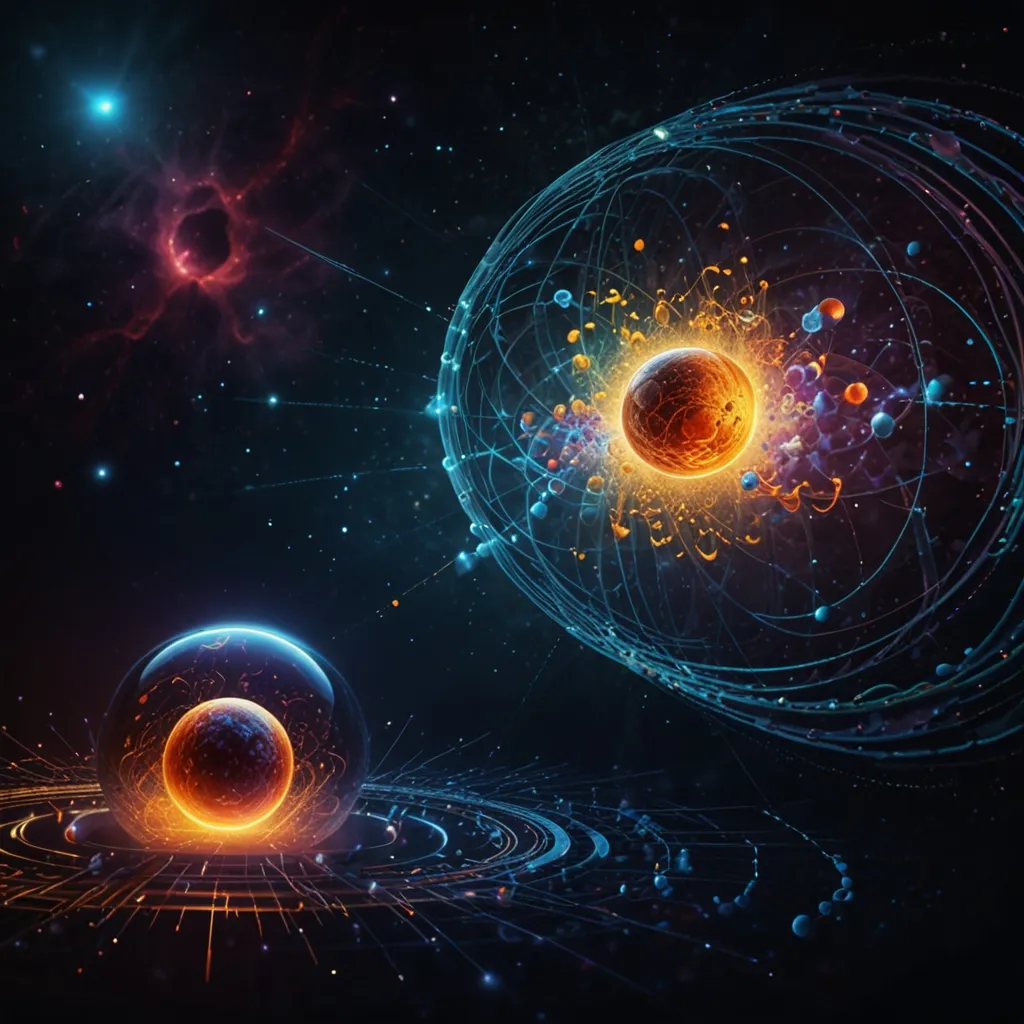
General relativity, though largely correct, falls apart at quantum scales. It can’t describe the singularity inside a black hole or at the Big Bang. These singularities are where quantum mechanics meets gravity, but general relativity’s equations break down here. The double slit experiment also highlights this incompatibility. Single photons or electrons fired one at a time through double slits create an interference pattern, showing wave-particle duality. Quantum mechanics predicts this behavior through wave functions, probabilities, until the wave localizes into a particle upon interaction.
But where is the gravitational effect of this wave? General relativity does not account for gravity acting like a wave function. Particles like photons and electrons must affect spacetime since they have energy or mass, influencing gravity, but we don’t know how this works on a quantum scale.
So, we know quantum mechanics works well on small scales and leads to classical mechanics on large scales. General relativity excels at macro scales but not micro. Gravity must work on the smallest scales; otherwise, its cumulative effects wouldn’t work on large scales. This makes physicists believe that general relativity is incomplete and must be integrated with quantum mechanics.
The standard model includes matter particles called fermions and force-carrying particles called bosons, mediating electromagnetism, the strong force, and the weak force. However, gravity doesn’t fit. General relativity describes it as a curvature of spacetime, not a force carried by particles. Gravity is the backdrop, the canvas on which the quantum mechanical world resides.
Despite its inaccuracies on small scales, general relativity isn’t wrong, just incomplete, much like how Newton’s laws were supplemented by Einstein’s work but still accurately describe many real-world phenomena. Any quantum theory of gravity must show that general relativity is correct in its classical limits.
Why is quantizing gravity so tough? When physicists try to mix gravity and quantum mechanics, infinities arise. In Feynman diagrams representing particle interactions, virtual particles can be created and annihilated an infinite number of times before reverting to their original state. These interactions yield infinite combinations and infinities in the equations. Richard Feynman devised a renormalization process to handle these infinities in quantum mechanics but applying this to gravity, which involves spacetime curvature, complicates things further.
Efforts like loop quantum gravity and string theory have tried to tackle this, but neither offers testable predictions or explains observed phenomena well. Even Einstein couldn’t reconcile gravity with quantum mechanics.
In all likelihood, a solution awaits discovery, possibly requiring a radical new approach to reality. Until then, the puzzle remains unsolved.
If you have questions about these ideas, feel free to ask. Understanding quantum gravity is one of science’s greatest challenges, and we’re all learning together. Thanks for reading.