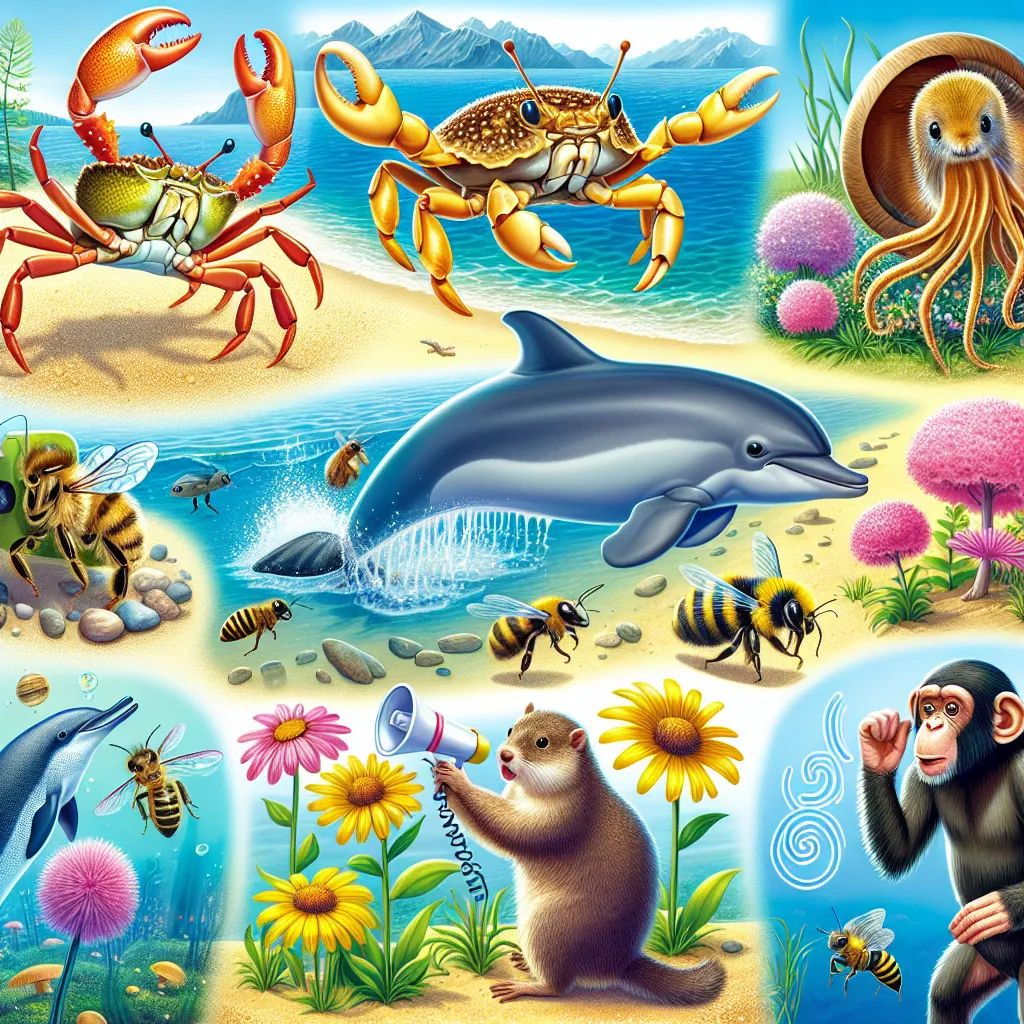
All animals have ways to communicate. Crabs wave their claws to show they’re healthy and ready to mate. Cuttlefish use special skin cells to change their colors, either to blend in or to warn off rivals. Honeybees perform intricate dances to tell other bees where to find food. It’s clear that these animals have impressive means of communication. But do any of them actually have a language?
Language has four key traits: discreteness, grammar, productivity, and displacement. Discreteness involves combining small units, like sounds or words, to form new ideas. Grammar is the set of rules for combining those units. Productivity is using language to create an infinite number of messages. Displacement lets us talk about things that aren’t right here and now, like events in the past or future.
Crabs and cuttlefish don’t really meet these standards. They don’t combine signals creatively or follow grammatical rules. Their communication is immediate and specific, like saying “I am healthy” or “I am poisonous.”
Some animals, though, do show a bit more language-like traits. Take bees. Their waggle dance describes the location and quality of food sources far from the hive, showing displacement. Prairie dogs have alarm calls that specify a predator’s size, shape, speed, and even if the predator is a human with a gun.
Great apes like chimps and gorillas are also good communicators. Some have even learned a form of sign language. For instance, a chimp named Washoe created new phrases from known signs like “Please open. Hurry.” A gorilla named Coco used signs to talk about her dead kitten, showing she could communicate about things not immediately present, a sign of displacement. But it’s worth noting these examples involved a human-created system, not natural wild communication.
Dolphins, too, have complex ways of talking. They use whistles to relay information about age, location, names, and gender. Researchers have even taught them some grammar through gestures. But this grammar isn’t seen in their natural communication.
While animal communication shows some aspects of language, none fully match all four key traits. Even the impressive signing of Washoe and Coco doesn’t reach the language skills of a typical three-year-old human. Plus, animals usually have limited topics. Bees focus on food, prairie dogs on predators, and crabs on themselves.
Human language is unique. Our brains can take a finite number of elements and create infinite messages. We construct and understand complex sentences, invent new words, talk about anything imaginable, and even lie.
Research into animal communication continues to grow. It might reveal that human language and animal communication are not entirely different but rather part of a spectrum. After all, we’re all part of the animal kingdom.