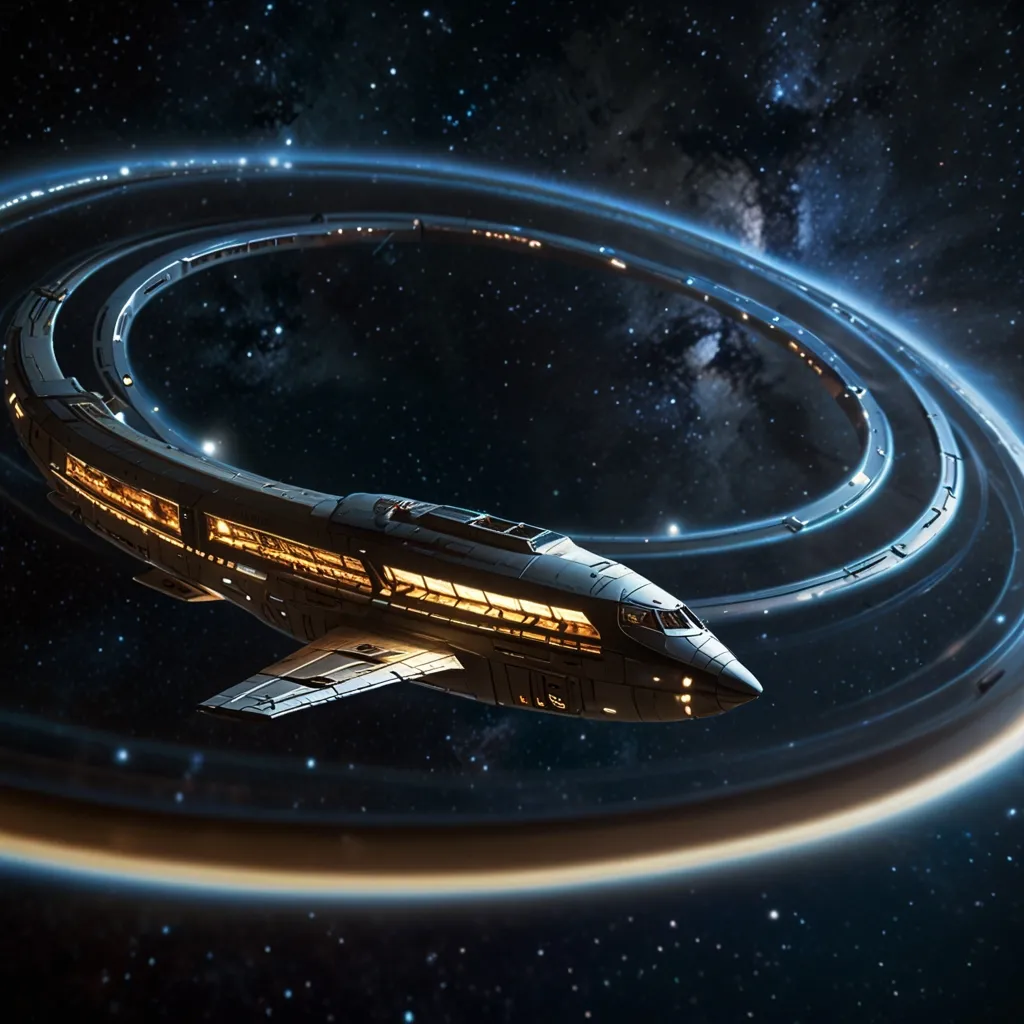
Spaceships with warp drive could potentially visit alien planets just as easily as we travel between continents. In sci-fi lore, ships like the Enterprise from Star Trek can achieve speeds up to nine thousand times the speed of light. Meanwhile, the Millennium Falcon from Star Wars boasts speeds of nine million times the speed of light. When you compare this to the fastest human-made object, the Juno probe around Jupiter, it’s mind-boggling. The Juno probe travels at 46 miles (74 kilometers) per second—0.0002 times the speed of light, to be precise. At this rate, it would take around 20,000 years to reach Proxima Centauri, the nearest alien planet. In contrast, with warp drive technology, this journey could be a day trip, completed in just nine hours.
Most people would assume warp drives are purely fictional and contradict Einstein’s theories. However, there’s more to it than meets the eye. To everyone’s surprise, there is some substantial scientific research backing the concept. The idea of a warp drive, although theoretical, is rooted in real physics.
In 1994, Mexican physicist Miguel Alcubierre, a great Star Trek fan, shocked the scientific community by publishing a paper on warp drive as a Ph.D. student. His work involved cleverly manipulating Einstein’s equations of General Relativity. Gravity, according to Einstein, is a geometric warping of space-time. By tweaking this geometry into a warp field, Alcubierre proposed a mathematical solution akin to a warp drive, even if its practical feasibility remained in question.
Imagine a spaceship encased in a bubble of space. If you could compress space in front and expand it behind, the bubble—and the ship within it—would appear to move. Alcubierre’s concept is like riding a wave on a surfboard; the space itself moves, while the ship remains stationary within the bubble. This neatly sidesteps the light-speed limit within space because the movement applies to space itself, not the objects within it.
This brings us to the fascinating point: space can indeed move faster than the speed of light. At the universe’s edge, space is expanding at speeds exceeding light. This fact supports Alcubierre’s idea that a warp bubble could theoretically move faster than light.
But the practicality involves major challenges. Important among them is the need for negative mass or energy to create a warp bubble. Negative matter, not to be confused with antimatter, has not been detected. This hypothetical substance would weigh less than zero and exhibit anti-gravity properties. Alcubierre’s solution originally required an enormous amount of negative energy, equal to all the mass in the universe, which was clearly impractical.
Enter NASA physicist Harold White, who revamped Alcubierre’s concept. White changed the warp bubble’s shape to a torus, making the energy requirements more realistic—around 700 kilograms worth. Though still enormous, it’s far less apocalyptic than the original.
Testing the warp drive concept has been intriguing but inconclusive. White’s team at NASA even made a small-scale attempt to warp space, aiming to alter a photon’s path. Achieving speeds even a fraction of light-speed, like 10%, would revolutionize space travel, making journeys thousands of times faster than our best technological capabilities today.
Is negative energy or anti-gravity realistic? Some hint at the Casimir effect, where closely positioned plates exhibit a kind of negative vacuum energy. However, this doesn’t entirely fit the bill for creating a warp drive.
The mysterious dark energy, which makes up 70% of our universe and causes its accelerated expansion, might offer hope. While we don’t yet understand or harness it, dark energy displays properties useful for a warp drive.
Science evolves through inspiration and innovation. Just as E=MC^2 led to nuclear power over 40 years, warp drives have gone from impossible to plausible within two decades. Given more inspiration, perhaps from popular culture like Star Trek, warp drives might transition from plausible to a tangible reality.