5 Historic Observatories That Revolutionized Our Understanding of the Universe Forever
Discover 5 historic observatories that revolutionized astronomy—from India's stone Jantar Mantar to Chile's ALMA telescope array. Explore how each breakthrough changed our cosmic perspective and scientific understanding forever.
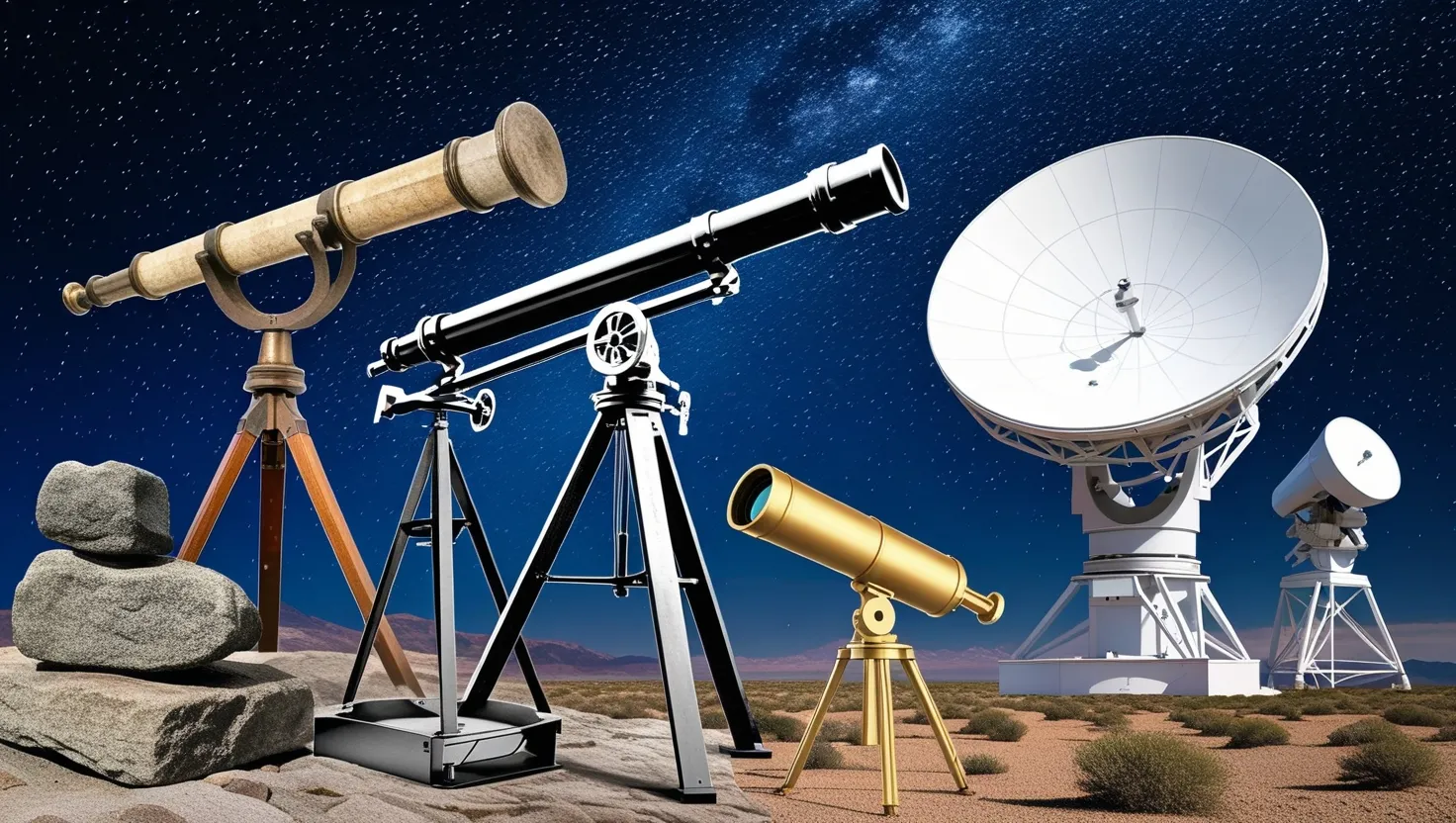
When you look up at the night sky, it’s easy to forget that our understanding of those pinpricks of light—stars, galaxies, new worlds—didn’t develop overnight. Each generation needed a vantage point, often literally, to see farther and more clearly. I want to take you on a journey to five historic observatories, each one a leap forward not only in technology but in the very questions we dare to ask about the universe. Prepare to see how blocks of stone, spinning metal dishes, and even the silence of a desert highland have changed the way we see everything.
Let’s start not with glass lenses, but with stone. In the early 1700s, Maharaja Jai Singh II constructed Udaipur’s Jantar Mantar—one of the subcontinent’s monumental outdoor observatories. It’s fascinating to me how, before the telescope became widespread, humans still designed instruments that rivaled the precision of many later inventions. Imagine walking between walls and stairs that aren’t just architecture, but careful calculations rendered in shadow and sunlight. At Jantar Mantar, it’s possible to measure time to the second and track the slow drift of planets—all with nothing but geometry and an understanding of how the sky sweeps overhead. These are not relics; they’re reminders of intellectual ambition long before glass and steel entered the picture.
As I consider the role of place, Europe’s Leiden Observatory highlights another turning point. Founded in 1633, it was the first university observatory on the continent. Here, astronomy wasn’t just about looking up; it became a discipline, a systematic pursuit. Decades before the spectroscope or high-tech detectors, astronomers such as Frederik Kaiser set new standards for careful observation. What strikes me is that Kaiser, using only modest telescopes by today’s standards, charted comets and stars so precisely that it revolutionized record-keeping and set new bars for measurement. Later, Heike Kamerlingh Onnes expanded the boundaries—literally—by reaching the lowest temperatures then known, ushering in discoveries that linked astronomy, physics, and chemistry.
“Somewhere, something incredible is waiting to be known.” That quote by Carl Sagan floats to mind as I think of Mount Wilson Observatory above Los Angeles. In the early 1900s, the world’s largest telescopes weren’t in Europe—they were in California’s dry, mountain air. Here, Edwin Hubble peered through the 100-inch Hooker telescope and discovered that the Milky Way was not the whole universe. Those mysterious spirals in the sky were not nebulae within our galaxy, but entire galaxies themselves, swarming beyond our starry boundary. This wasn’t just about seeing farther. It was about understanding that the universe was larger, older, and more dynamic than anyone imagined. Hubble’s conclusions didn’t just remap galaxies; they shifted cosmology, forcing us to rethink the origin and fate of, well, everything.
Have you ever wondered how we listen to the universe, not just look at it? In the town of Parkes, Australia, a massive metal dish stands ready to catch whispers from deep space. Since 1961, the Parkes Radio Telescope has been tuning in to a cosmos humming with signals beyond visible light. One of my favorite stories is July 1969, when Parkes received and broadcast the first live TV images of Neil Armstrong stepping onto the moon. But Parkes isn’t just about human triumph. Its ability to detect distant pulsars and galaxies has transformed radio astronomy from an experimental field into a key cosmic probe. Radio waves slice through dust that would obscure optical telescopes, revealing everything from the leftovers of ancient supernovas to the rhythmic blinks of spinning neutron stars.
Asking different questions requires new eyes. That’s what the Atacama Large Millimeter/submillimeter Array (ALMA) offers in Chile’s high, cold Atacama Desert. Instead of a single dish, ALMA brings together 66 radio telescopes. By linking them into a giant virtual instrument, astronomers can see details in clouds of gas and dust invisible to optical telescopes. I find it particularly thrilling that ALMA lets us peer into the cold nurseries where stars and planets are born—places that, until recently, were largely hidden from view. In a sense, ALMA isn’t just a collection of cutting-edge machinery. It’s a collaboration that crosses continents, as scientists from around the world share data to build a truer image of cosmic beginnings.
“Equipped with his five senses, man explores the universe around him and calls the adventure Science.” Edwin Hubble’s words echo the spirit of these observatories. Each is different not just in architecture or approach, but in the questions they made possible. Jantar Mantar’s stone instruments proved that precision doesn’t require modernity. Leiden’s scholars showed that careful measurement and record-keeping drive genuine progress. Mount Wilson’s giant telescopes opened up new realms of space, shifting the scales on which we measure existence. Parkes demonstrated that cosmic discovery isn’t a silent pursuit; we can listen as well as look. ALMA, finally, brings us into a new era—one of teamwork, where no single nation or scientist can claim the universe alone.
Curiously, many of the most profound discoveries were not just about hardware or location, but about the persistence and curiosity of the people involved. How many cold nights did Jai Singh’s astronomers watch the sky, adjusting instruments to fractions of a degree? Imagine the patience required at Leiden, where every observation was written out by hand, often over years, to ensure no detail was lost. At Mount Wilson, Hubble’s careful measurements of fuzzy smudges on photographic plates led to entirely new physics, while at Parkes and ALMA, teams work through immense sets of data, always searching for signals other eyes or ears might miss.
What does it take to change our view of the universe? Is it bigger instruments, sharper eyes, or simply asking more interesting questions? Perhaps it’s a combination—human ingenuity meeting natural wonder at just the right moment. You might be surprised to know that even now, observatories like Jantar Mantar continue to inspire. Modern astronomers study these ancient sites to understand orbital mechanics or learn from the precision ancient scientists achieved by different means. Meanwhile, places like ALMA remind us that we’re still only at the beginning of our cosmic adventure.
As I reflect on these observatories, I’m struck by how they connect us across centuries and continents. You might never stand in Udaipur’s courtyards, feel Leiden’s north sea wind, gasp at Mount Wilson’s mountain views, visit Parkes’ outback dish, or touch ALMA’s windswept antennas. But each, in its way, gave us new ways to see, to ask, to wonder. In their shadow, we look up—not just at the stars, but at our own capacity to understand.
“To confine our attention to terrestrial matters would be to limit the human spirit,” Stephen Hawking once said. As you pause the next time you look at the stars, consider that what you see owes much to a handful of visionary sites and the questions they dared to ask. What questions will we ask next?