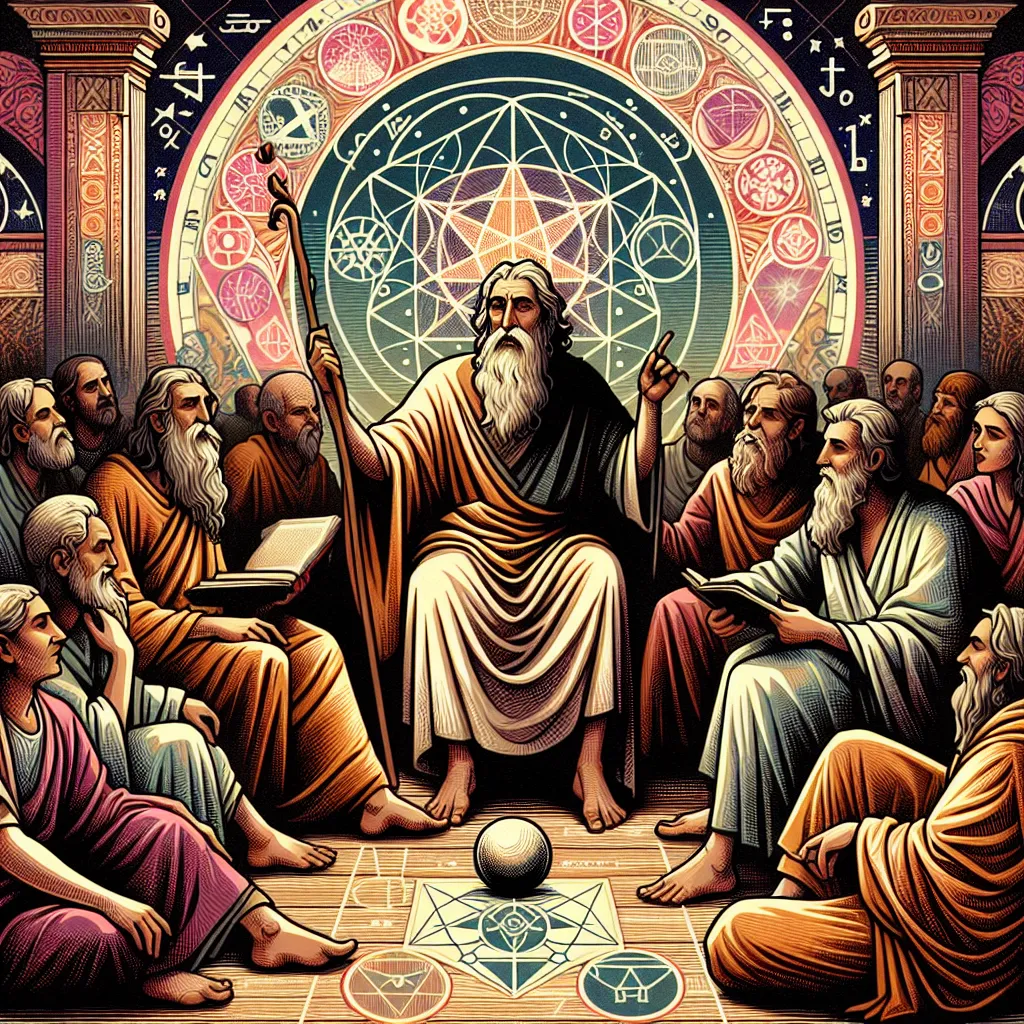
Pythagoras is one of those names that inevitably makes an appearance in our school textbooks, usually with a geometric twist. You know, that famous theorem involving right-angled triangles. But who was Pythagoras, really? Let’s dig a bit deeper into the life of this enigmatic figure.
Pythagoras lived sometime during the 6th to 5th centuries BC, making him one of the earliest figures in Western philosophy. He’s often overshadowed by legends, making it hard to separate fact from fiction. Unlike his better-documented counterparts like Socrates, Plato, and Aristotle, Pythagoras left no writings behind. Much of what we know about him comes from accounts written centuries after his death, which adds a layer of mystery to his life and teachings.
Despite this fog of legend, we can trace certain aspects of his life and beliefs. Born on the island of Samos, Pythagoras later moved to Croton in southern Italy, where he gathered a group of dedicated followers. He became famed not for his mathematical skills but as a wonder-worker, a kind of sage who performed what were seen as superhuman feats. His followers, known as the Pythagoreans, adhered to a strict and somewhat kooky set of rules and rituals.
Interestingly, Pythagoras is often painted not just as a mathematician but also as a spiritual leader. He espoused beliefs like the immortality of the soul and reincarnation, ideas that were quite groundbreaking for his time. There’s a quirky legend where Pythagoras hears a dog’s yelp and claims it harbors the soul of a deceased friend, recognizing the soul by its scream. His thoughts on reincarnation perhaps explain why he and his followers practiced vegetarianism, fearing they might consume reincarnated souls if they ate meat.
The Pythagorean way of life was full of strange rules. They couldn’t enter temples barefoot, weren’t allowed to sacrifice white animals, and had an odd aversion to beans, believing beans had some kind of mystical and ominous essence. The group’s life was also characterized by silence, both literally and metaphorically, as they were sworn to secrecy about their esoteric teachings.
Now, while Pythagoras is mostly celebrated for his geometric contributions, particularly the Pythagorean theorem, he wasn’t just about mathematics. His teachings touched upon numerology, geometry, music theory, and a mystical concept known as the “harmony of the spheres.” This idea suggested that the movements of celestial bodies produce a kind of music, inaudible to human ears but harmonically perfect.
Pythagoreanism evolved remarkably over the centuries. In the 4th century BC, the movement, split into two camps: one focused on religious rituals, and the other more on the philosophical and mathematical aspects. Later philosophers like Plato were heavily influenced by these teachings, which survived well into the development of Neoplatonism.
Even after Pythagoras’s time, the Pythagoreans were seen as a unique group. They were the ancient ‘hippies’ of their time with their simple clothes, unkept beards, and vegetarian diets. The phenomenon continued to intrigue and influence people for centuries.
So the next time you hear Pythagoras’s name, think beyond the theorem. Picture an ancient sage, a spiritual leader with followers living an enigmatic existence filled with secretive teachings, esoteric rituals, and fascinating philosophies. He’s a lot more than that triangle guy from your geometry class.