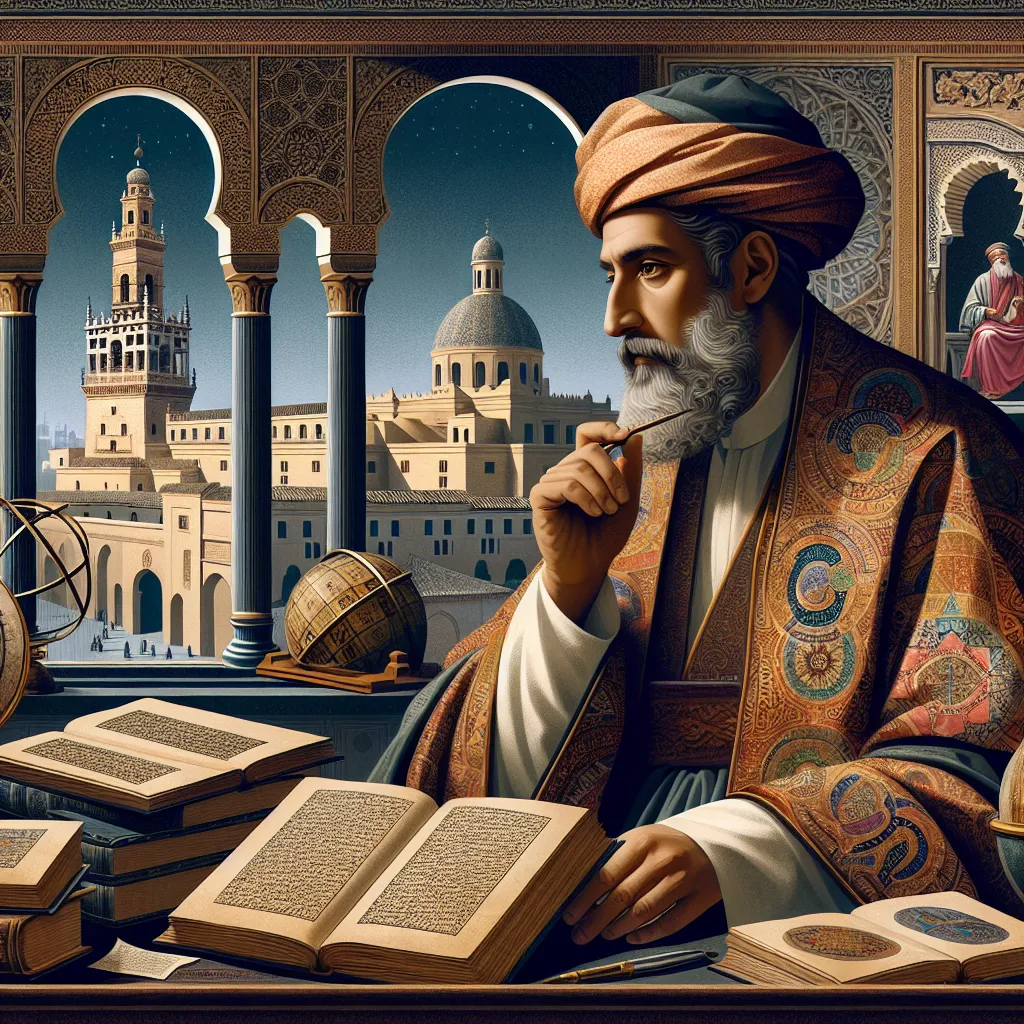
Islamic philosophy often gets condensed into a simplistic timeline starting with al-Kindi in the 9th century and ending with Averroes (Ibn Rushd). But this view overlooks the rich and complex evolution of thought in the Islamic world. Ibn Rushd, however, is a vital figure to zero in on. Born in Cordoba, Spain, in 1126, he was an intellectual powerhouse, writing over a hundred books on topics ranging from theology to astronomy.
Ibn Rushd’s life was as colorful as his mind. Raised in a family of respected scholars, he received a well-rounded education that included religious sciences and philosophical studies. His journey took him to Marrakesh, where he met the influential philosopher Ibn Tufail, who introduced him to the then-ruling Almohad Caliph, Abu Yaqub Yusuf. This meeting marked the start of Ibn Rushd’s influential career. He became the Caliph’s court physician and later served as the chief judge in Cordoba.
An ardent admirer of Aristotle, Ibn Rushd believed in pure rationalism and critiqued philosophers like Ibn Sina for blending Aristotelian thought with Neoplatonism. He rigorously defended the compatibility of philosophy and religion, arguing that rational inquiry was not just allowed but required by the Quran for those capable of it.
His most famous works include “The Incoherence of the Incoherence,” a rebuttal to Al-Ghazali’s criticism of philosophers, and “Fasl al-Maqal,” which argued for the harmony of religion and philosophy. Ibn Rushd believed that demonstrable truths should always take precedence over religious texts when the two appeared contradictory, advocating an allegorical interpretation of scripture in such cases.
Despite his rationalist approach, Ibn Rushd’s commitment to Islam was profound. He meticulously balanced his roles as a philosopher and a devout Muslim, asserting that true philosophical insights and religious truths were fundamentally aligned.
Ibn Rushd’s progressive views extended even to social issues like gender roles. In his commentary on Plato’s “The Republic,” he lamented the societal confinement of women and argued for their active participation in society, a stance that was quite forward-thinking for his time.
Interestingly, while Ibn Rushd’s work had a monumental impact on European scholasticism, he was somewhat neglected in the Islamic world after his death in 1198. European thinkers like Thomas Aquinas and Maimonides held his commentaries in high regard, often reading Aristotle with Ibn Rushd’s annotations close by.
Historically, Ibn Rushd’s brilliance bridged Islamic intellectual heritage with European thought, significantly influencing the Western philosophical canon. Though underappreciated in his own culture posthumously, his legacy endures as a testament to the universal quest for knowledge and truth.