In the annals of history, few names resonate with the breadth and depth of influence quite like the Persian philosopher and polymath, Ibn Sina, known in the West as Avicenna. His contributions spanned across multiple fields, notably impacting both the Islamic intellectual tradition and European thought. Avicenna was especially revered for his medical works which remained authoritative texts in Europe until the 18th century.
One of the most celebrated aspects of Avicenna’s intellectual legacy is his argument for the existence of God, famously known as “The Proof of the Truthful.” This argument is primarily rooted in the concepts of contingency and necessity.
To understand his argument, it’s important to grasp what Avicenna means by contingency. When he looks at the world, everything in it seems to be contingent, meaning dependent on something else for its existence. For instance, a table exists because someone decided to make it, but it also exists because its parts—the wood, screws, and varnish—exist. These too are contingent because they are dependent on their own materials and conditions.
Avicenna posits that if everything we observe is contingent, it begs the question of whether there can be something that is necessary—a necessary existence that doesn’t depend on anything else and must exist by its own nature. This necessary existence would be fundamentally different from contingent beings because it wouldn’t be caused by anything else.
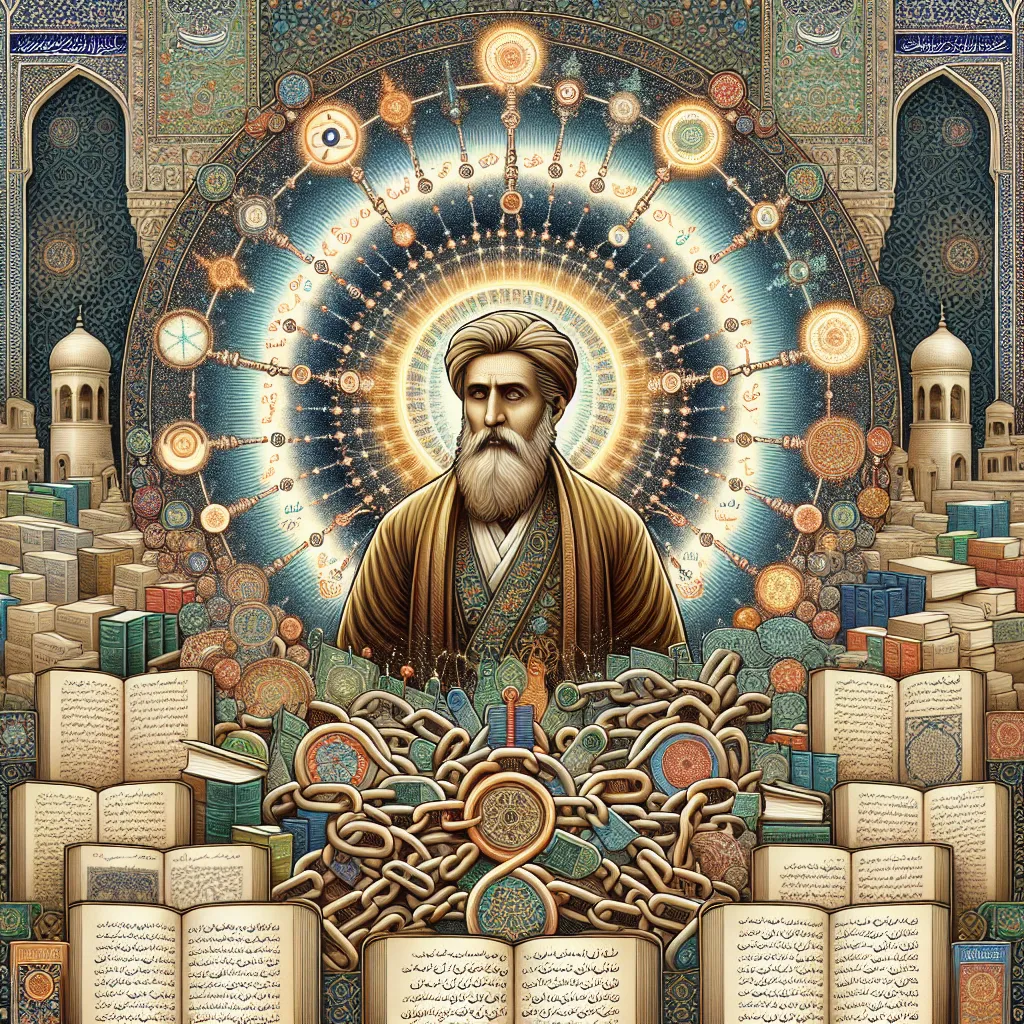
He argues that if we trace back the chain of contingent existences, we will find that it cannot go on infinitely. At some point, there must be a necessary existence that initiates this chain. This necessary existence must be simple and indivisible because if it were made up of parts, it would be contingent.
Therefore, Avicenna concludes that this necessary existence is what we understand as God. God is beyond time and space, immaterial, and not composed of any parts. He is unique, with no equal or opposite, and cannot be defined by genus or species but only by the pure understanding of intellectual knowledge.
Avicenna further aligns his argument with the theological tenets of Islam by asserting the principle of monotheism. He argues that there cannot be more than one necessary existence because if there were two or more, they would differ in some respects, making them dependent on those distinguishing aspects and thus not truly necessary.
Avicenna’s proof has endured through the ages, influencing countless thinkers and scholars. He demonstrated that a necessary existence, which we call God, aligns perfectly with the Islamic concept of a singular, omnipotent deity.
For those who want a deeper dive into Avicenna’s proofs and arguments, some excellent resources and visual guides can offer more detailed breakdowns, making these complex ideas more accessible and engaging.