In my article about Taoism, I delved into how this religion has evolved into many shapes and forms throughout history. It’s almost impossible to define it as a coherent religion in the conventional sense because it encompasses everything from politically entangled, ritualistic practices to a total escape from society with free-flowing ascetic attitudes.
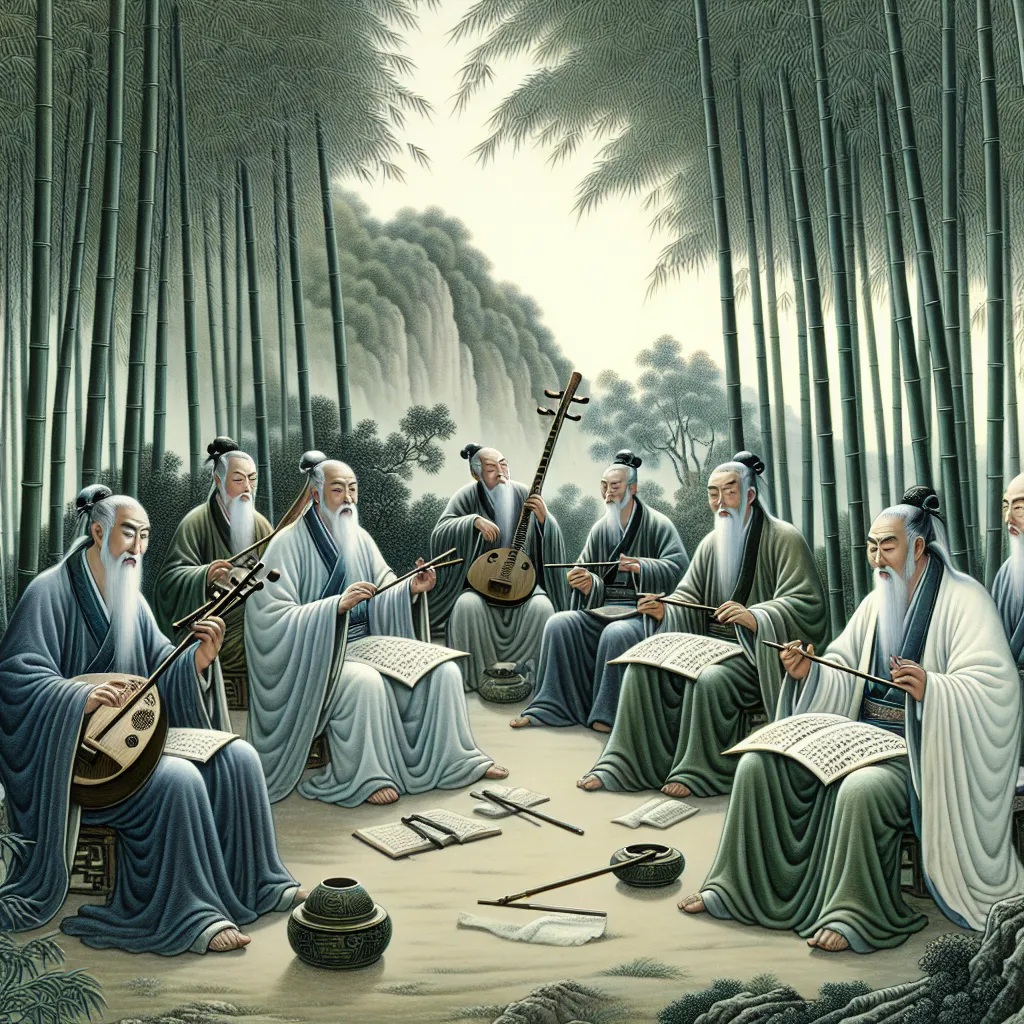
Take, for instance, the Seven Sages of the Bamboo Grove, who are legendary in Chinese culture. These scholars, poets, and musicians lived during the turbulent third century in China, a time marked by the fall of the Han Dynasty and the chaotic Three Kingdoms period. Amid the political corruption and social upheaval, this group found solace in nature and simplicity.
These seven intellectuals grew disillusioned with the corrupt politics of the Wei Dynasty. They retreated to a bamboo grove, where they immersed themselves in poetry, music, nature, and perhaps, as some stories suggest, psychedelic substances. This act of withdrawal aligns perfectly with Taoist principles like “wu wei” or effortless action—living freely, spontaneously, and harmoniously with nature and the Tao.
Among them was Ji Kang, a writer, poet, musician, and alchemist whose estate bordered the grove. He played the guqin, an ancient Chinese string instrument deeply tied to Taoism. Another sage, Liu Ling, was a Taoist poet and alcohol aficionado. Ruan Ji, another prominent figure, was a master musician and poet who famously criticized the ruling class through allegory to avoid persecution. He even stayed drunk for 60 days to resist an arranged political marriage.
These sages all shared a desire to escape the chaotic world and to live simply. They expressed their Taoist ideals through music and poetry, often reaching ecstatic states where they’d jump into water to cool off and then craft inspired verses.
The story of the Seven Sages of the Bamboo Grove has taken on a legendary status. While it’s debatable whether they regularly gathered in this bamboo grove, their legendary tale resonates deeply within the Chinese consciousness. They symbolize a yearning for a simpler life, free from the tangled web of politics and social chaos—a life filled with expression, good companionship, nature, and harmony.
In these challenging times of pandemics, wars, and political instability, the idea of escaping to enjoy music, poetry, and nature with friends is increasingly alluring. So, if I suddenly stop publishing videos, you know where I might be hiding. See you next time!