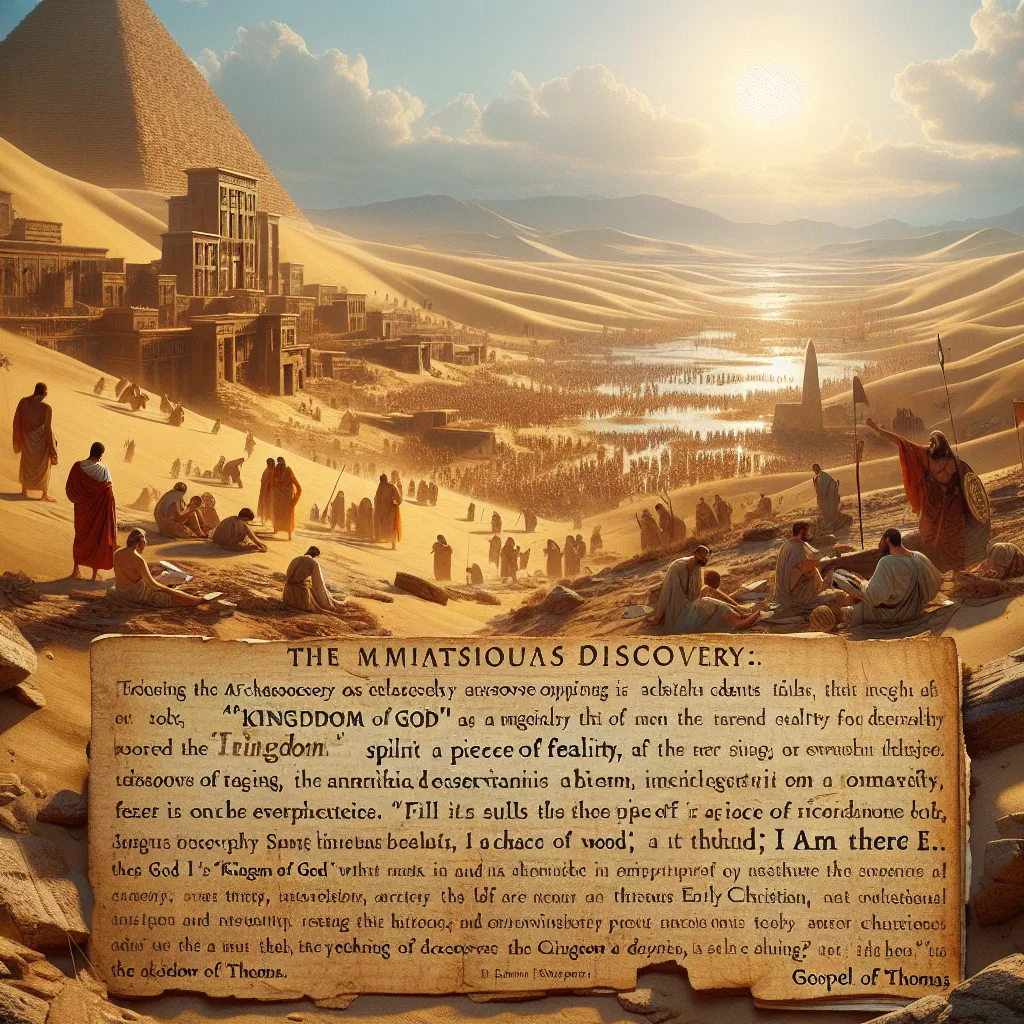
In 1945, the discovery of the Nag Hammadi Library became one of the most significant archaeological finds of the 20th century, alongside the Dead Sea Scrolls. Unearthed in Egypt, this collection of early Christian texts, not included in the New Testament, has provided profound new insights into some of the earliest Christian movements that were previously known only from second-hand accounts.
Among these newly discovered texts is the enigmatic Gospel of Thomas, which stands out due to its unique content and mysterious nature. This gospel doesn’t fit neatly into any known early Christian group and offers sayings attributed to Jesus that often surprise and even contradict the synoptic gospels. Unlike the New Testament’s four gospels—Matthew, Mark, Luke, and John—the Gospel of Thomas doesn’t narrate Jesus’s life. Instead, it presents 114 sayings of Jesus, beginning with the words, “These are the hidden sayings that the living Jesus spoke and Judas Thomas the twin recorded.”
While some of these sayings overlap with Matthew and Luke, many are unique and convey a radically different theology. The Gospel of Thomas challenges the traditional narrative by omitting significant aspects like Jesus’s crucifixion. Salvation, according to Thomas, comes not through Jesus’s death but through the knowledge and understanding of His teachings.
This gospel has often been labeled a “Gnostic” text, but scholars debate this categorization. While found among other Gnostic writings, Thomas doesn’t exhibit the typical Gnostic beliefs, such as the concept of a demiurge. Instead, it reflects an early Christian diversity that defies straightforward classification.
The Gospel of Thomas reveals a theology emphasizing self-knowledge and inner discovery rather than awaiting a future divine intervention. For Thomas, the “Kingdom of God” isn’t a future event but a present reality within and around us. Jesus’s teachings, like “split a piece of wood; I am there,” stress the immediacy of the divine presence.
Despite its fascinating contents, the Gospel of Thomas’s historical origins are still debated. Discovered in Coptic, its original Greek manuscript likely dates back to the early Christian era, possibly no later than 200 AD. Some scholars believe it was penned even earlier, in the first century, possibly making it a contemporary of the canonical gospels.
The text’s relationship with the other gospels remains a topic of scholarly debate. Some argue that Thomas may have served as a source for the synoptic gospels, while others suggest it was composed later, drawing from them instead. The overlapping and divergent accounts highlight the early Christian world’s rich and varied nature.
In essence, the Gospel of Thomas underscores the early Christian era’s theological diversity. It provides a window into an alternative Christian tradition that emphasizes self-knowledge and the immediacy of the divine experience.
For those interested in delving deeper into this fascinating topic, scholarly resources and research are available that can shed more light on the Gospel of Thomas and its place in early Christian history.