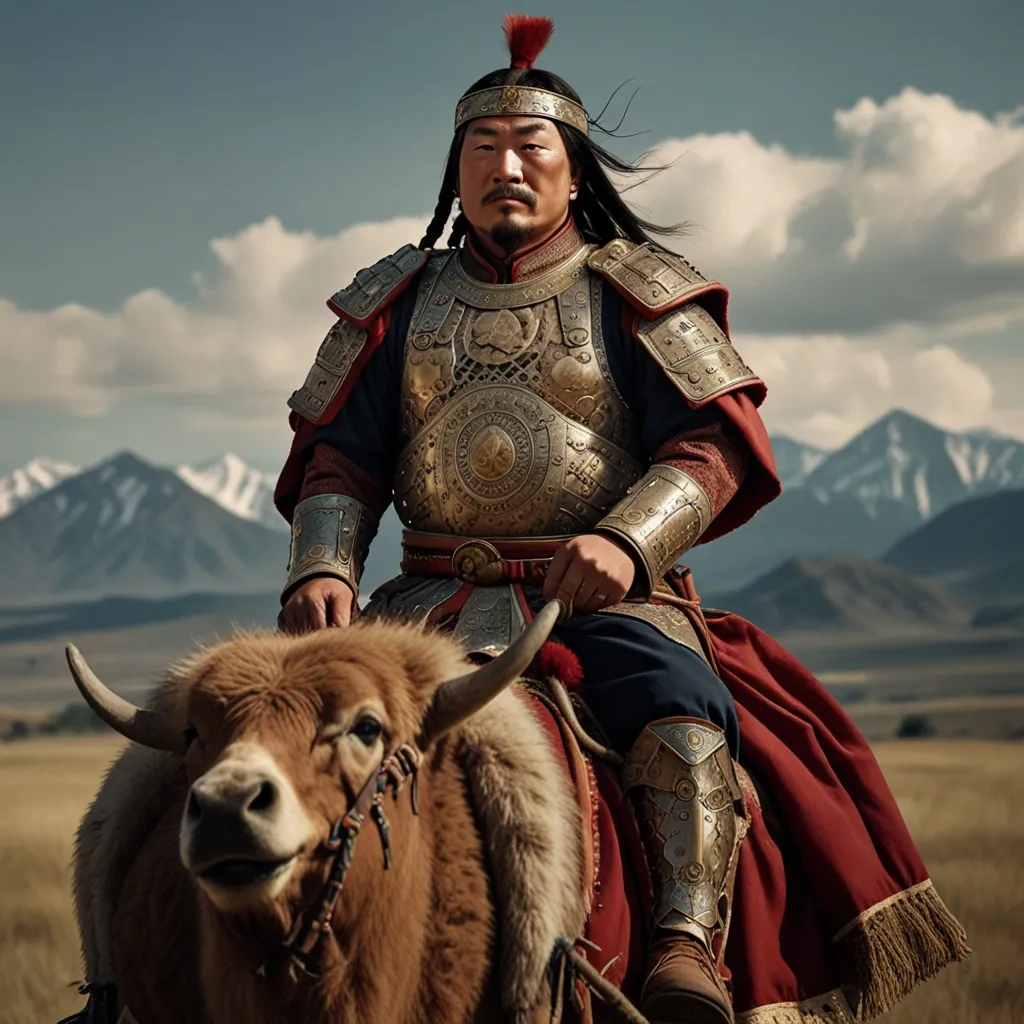
Genghis Khan, born around 1162 near Lake Baikal in Mongolia, is one of the most famous conquerors in history. He started his life as Temüjin, a name given to him after a leader his father had defeated. His early years were marked by hardship and struggle. When he was just nine years old, his father, Yesügei, was poisoned by a rival tribe, leaving Temüjin and his family in a precarious situation. Despite these challenges, Temüjin grew into a strong and determined leader.
In 1206, Temüjin was proclaimed the ruler of all Mongols and took the title Genghis Khan, meaning “universal ruler.” This marked the beginning of the Mongol Empire, which would eventually become the largest contiguous empire in history. Genghis Khan united various Mongol tribes and began a series of campaigns that would extend his empire from the Pacific coast of China to the Adriatic Sea in Europe.
Genghis Khan’s military prowess was unmatched. He introduced advanced technologies such as the stirrup, composite bows, and leather armor, which gave his warriors a significant advantage over their enemies. His military tactics included arrow storms, hit-and-run attacks, and psychological warfare, making his army nearly invincible. The Mongols were also known for their lightning-fast communication system, using horses to relay messages across vast distances.
Under Genghis Khan’s leadership, the Mongols conquered a vast territory, creating a unified empire that stretched across Asia and into Europe. This empire was not just a collection of conquered lands but a cohesive political entity with a sophisticated system of administration. The Mongols adopted the administrative systems of the conquered states, placing a few Mongols in key positions while allowing local officials to manage everyday affairs. This approach allowed them to maintain control while staying connected to the local population.
The Mongol Empire was also a period of cultural development and artistic achievement. The Pax Mongolica, or Mongol peace, facilitated trade and the exchange of ideas across the empire. Artists and craftsmen were transferred along the main trade routes, integrating new influences with established local traditions. By the middle of the thirteenth century, the Mongols had united Chinese, Islamic, Iranian, Central Asian, and nomadic cultures under a single overarching Mongol sensibility.
Genghis Khan’s successors continued to expand the empire. His grandson, Khubilai Khan, founded the Yuan dynasty in China, which became the central and most important branch of the Mongol Empire. Other branches included the Chagatai khanate in Central Asia, the Golden Horde in southern Russia, and the Ilkhanid dynasty in Greater Iran. These branches were connected through an intricate network of communication and trade routes.
The Mongols were not just conquerors; they were also patrons of culture and learning. They adopted and assimilated the cultures of the regions they conquered, leading to a period of extraordinary artistic and cultural development. For example, the Ilkhanid dynasty in Iran combined Chinese models with local traditions, creating a unique period in Islamic art.
Despite its reputation for brutal warfare, the Mongol Empire also brought about a period of peace and stability known as the Pax Mongolica. This period allowed for protected travel and trade, connecting the East with the West and facilitating the exchange of goods, technologies, and ideas across Eurasia. The Mongols also embraced religious freedom and supported trade, which helped stabilize the economy and promote cultural exchange.
Genghis Khan’s legacy extends beyond his military conquests. He reformed the laws of his people, introduced a military-feudal form of government, and supported rural cooperatives. His vision and leadership transformed a group of nomadic tribes into a powerful empire that lasted for centuries. Even today, Genghis Khan is remembered as one of history’s greatest leaders, whose impact on world history is still felt.
The Mongol Empire eventually split into four main branches due to disputes over succession. The Toluids prevailed after a bloody purge of other factions, but the empire continued to fragment. By 1368, all four branches had folded, marking the end of the Mongol Empire. However, the legacy of Genghis Khan and the Mongols continues to influence modern society, from the Silk Road to the cultural and artistic achievements that remain a testament to their enduring impact.
In summary, Genghis Khan was the first ruler of the Mongol Empire, a visionary leader who united various tribes and expanded his empire through military prowess and cultural assimilation. His legacy includes the creation of the largest contiguous empire in history, the promotion of trade and cultural exchange, and the establishment of a period of peace and stability known as the Pax Mongolica.