Could One Man's Fight for Justice Really Change the Course of American History?
Blazing a Trail: The Legacy of Thurgood Marshall in the Fight for Justice
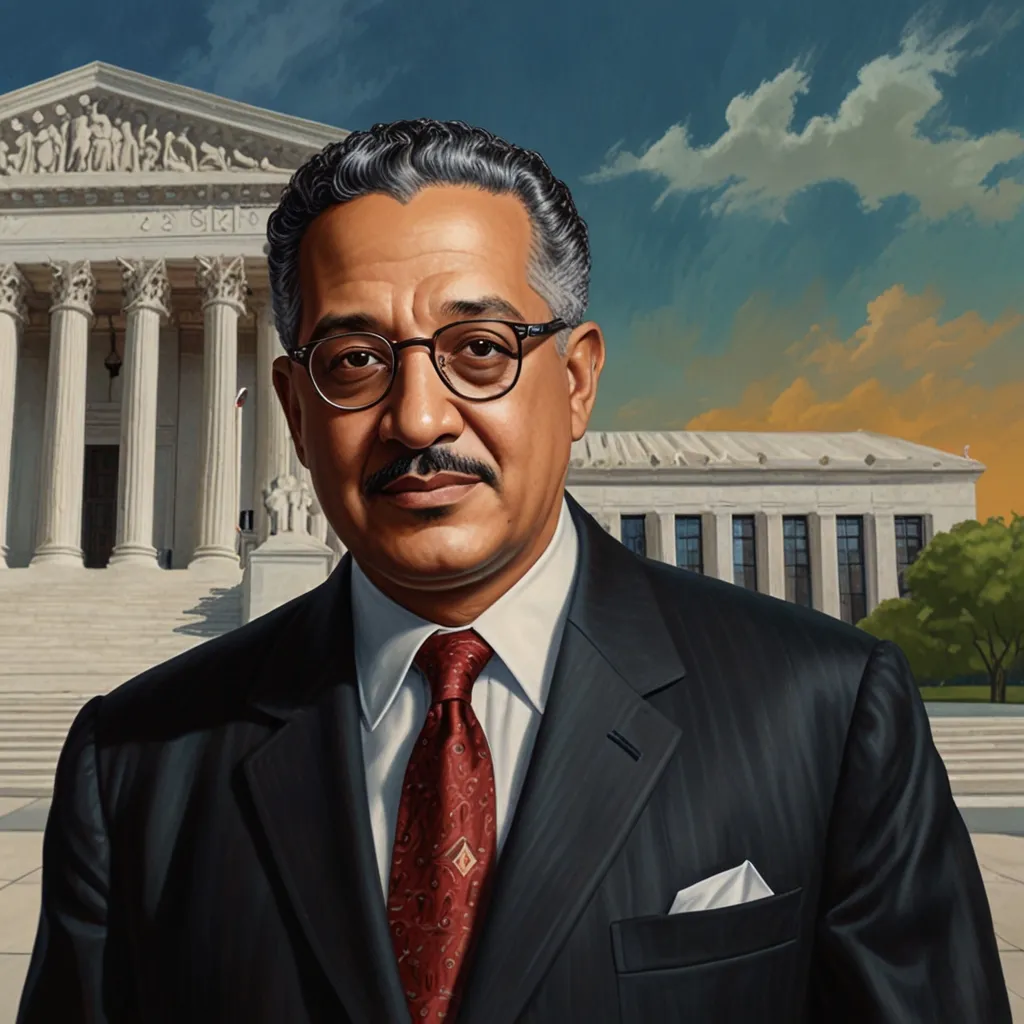
Thurgood Marshall was a trailblazer in American history, becoming the first Black Supreme Court justice in the United States. His journey to this prestigious position was marked by his relentless fight against racial discrimination and his commitment to equal justice for all.
Born in Baltimore, Maryland, Marshall faced early challenges when he was rejected from the University of Maryland Law School because of his race. Undeterred, he went on to graduate from Howard University Law School, where he met his mentor, Charles Hamilton Houston. Houston instilled in Marshall the belief that the law could be a powerful tool for social change.
Marshall’s legal career began with a bang when he successfully argued the case of Murray v. Pearson against the University of Maryland Law School. This victory set the stage for his future legal battles against segregation. He joined the NAACP and quickly rose through the ranks, becoming the chief of the NAACP Legal Defense and Educational Fund.
Marshall’s most famous case was Brown v. Board of Education, which he argued before the Supreme Court in 1954. This landmark decision declared that “separate but equal” was unconstitutional in public schools, effectively ending segregation in education. This victory was a significant milestone in the civil rights movement and cemented Marshall’s reputation as a legal giant.
His success in the courtroom did not go unnoticed. President John F. Kennedy nominated Marshall to the U.S. Court of Appeals for the Second Circuit in 1961. Four years later, President Lyndon B. Johnson named him U.S. Solicitor General. Johnson’s nomination of Marshall to the Supreme Court in June 1967 was a historic moment, marking the first time a Black person would serve on the highest court in the land.
Marshall’s confirmation was not without its challenges. Southern senators opposed his nomination, fearing his liberal stance and civil rights background. Despite these obstacles, Marshall was confirmed by a 69-11 vote on August 30, 1967. He took his oath of office in September 1967 and began his 24-year tenure on the Supreme Court.
On the bench, Marshall continued his fight for equal justice. He was a strong advocate for affirmative action, opposed the death penalty, and supported women’s rights. His opinions were often passionate and eloquent, reflecting his deep commitment to justice and equality.
Marshall’s legacy extends far beyond his time on the Supreme Court. He is remembered as a champion of civil rights, a man who used the law to dismantle segregation and fight discrimination. His impact on American society and culture is immeasurable, and his mission of equal justice for all continues to inspire generations.
After retiring from the Supreme Court in 1991, Marshall passed away in 1993. His legacy was honored by the Supreme Court, which recognized his significant contributions to constitutional law both before and during his time on the bench. Today, Thurgood Marshall remains a symbol of hope and justice, a reminder that the law can be a powerful tool for change.