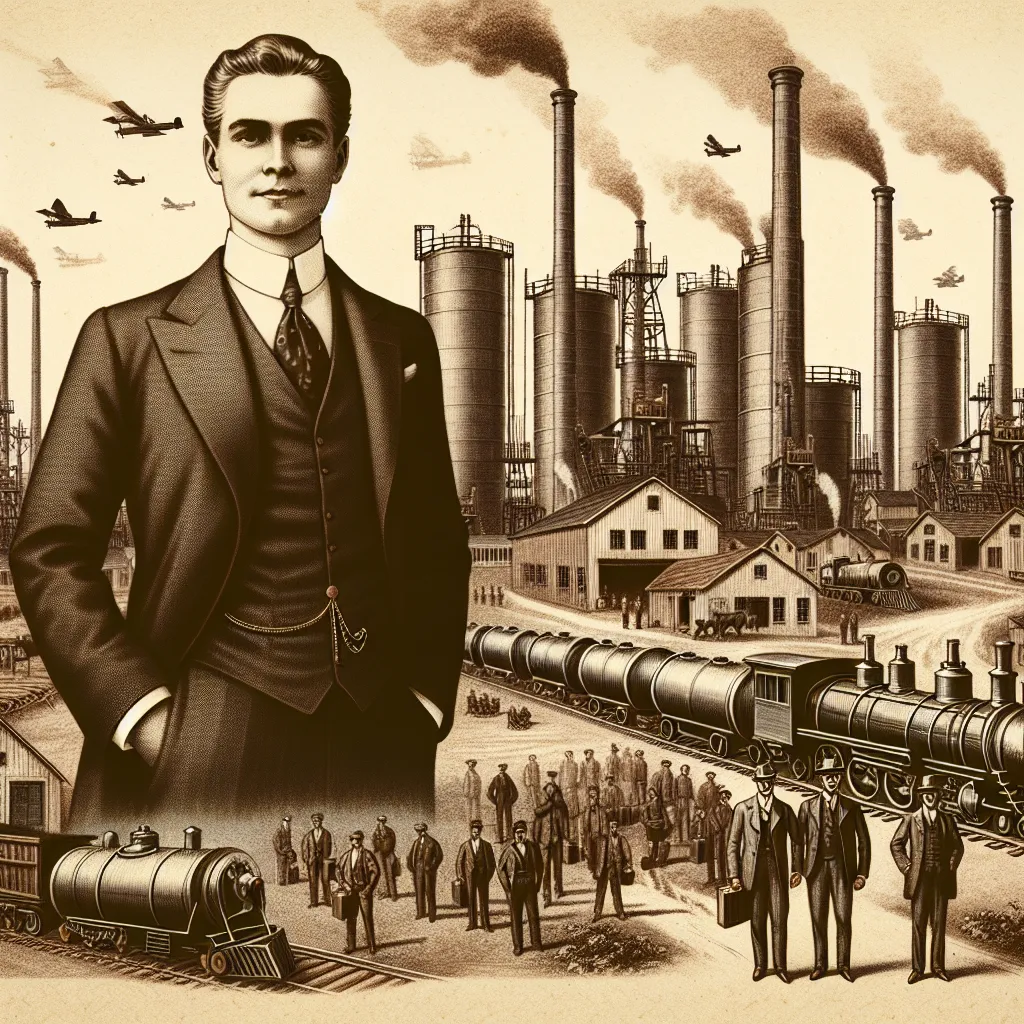
When we think of the wealthiest people today, names like Jeff Bezos and Bill Gates often come to mind. However, the richest businessman ever passed away nearly a century ago. This is the story of John Rockefeller and the vast empire of Standard Oil.
John Rockefeller was born in 1839 in upstate New York, the eldest son of a traveling merchant who dabbled in pseudo-medicine. Growing up, John learned to make the most out of every opportunity. His family’s nomadic lifestyle meant he was always hustling, whether it was raising turkeys or doing odd jobs for neighbors.
In 1854, the Rockefellers moved to Cleveland, Ohio, where John got a chance to attend school. But within a year, his educational journey ended as he took a job as a bookkeeper at a local produce broker, earning just $0.50 a day. After two years and no prospect of a meaningful raise, John borrowed $4,000 to start his own brokerage. He began trading hay, grain, and meats, quickly turning a modest profit and attracting the attention of Cleveland’s banks.
Then, in 1859, something happened that would change his life forever: the first American oil well was discovered in Pennsylvania, sparking an oil rush. John realized the true money was not in drilling but in refining oil. After waiting for a rail line to connect the Pennsylvania oil fields to Cleveland, he jumped into the oil refining business in 1863, optimizing it to make the most out of every drop.
John’s refinery quickly became one of the largest in Cleveland. By 1870, he had incorporated it as Standard Oil of Ohio. His tactic of buying out competitors and luring their best minds to his company allowed him to control almost all of Cleveland’s refineries. By 1880, Standard Oil was refining over 90% of America’s oil.
Rockefeller’s power grew as he negotiated deals directly with rail companies to secure preferential rates. This angered other industrialists, leading to political and media backlash. Despite the efforts to regulate Standard Oil, John stayed ahead by reorganizing his company and building an enormous headquarters on Broadway.
At its peak, Standard Oil controlled a huge chunk of the oil industry, employing over 100,000 people and owning thousands of oil wells and miles of pipelines. However, with new oil discoveries abroad and the passage of the Sherman Antitrust Act, huge legal battles ensued. Finally, in 1911, the Supreme Court ordered the breakup of Standard Oil into 34 separate entities.
Ironically, this breakup became the most profitable event for Rockefeller. Most of these entities eventually merged into ExxonMobil, Chevron, and BP, and John retained substantial holdings in them. His net worth soared to an estimated $400 billion, making him the richest businessman ever, dwarfing even modern billionaires like Jeff Bezos.
This tale of ambition, strategic genius, and unparalleled wealth reminds us of the incredible legacy left by John Rockefeller, a legacy that remains unmatched even today.