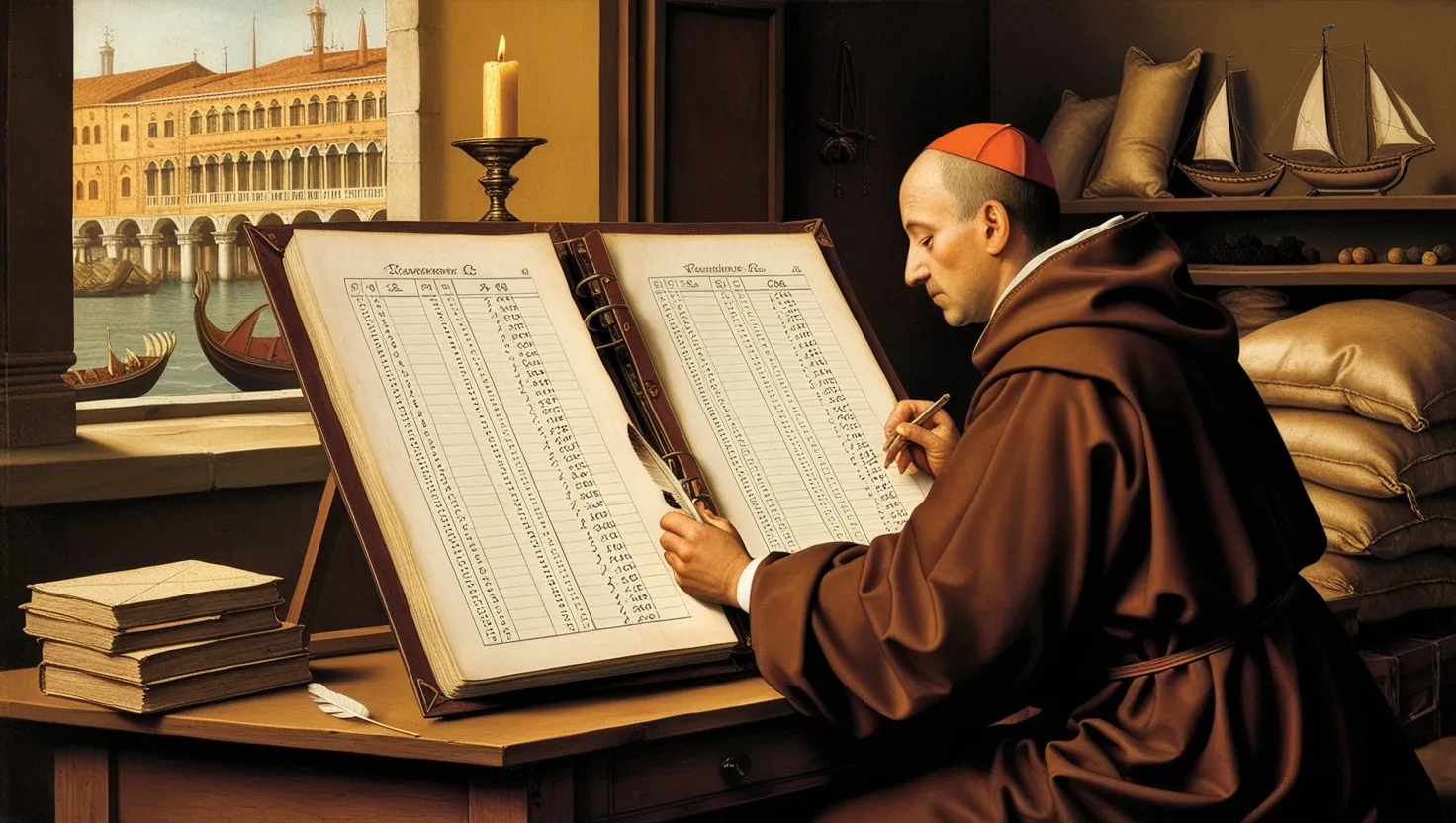
I want you to picture a Venetian merchant in the year 1400. He has a warehouse full of spices, a ship somewhere in the Mediterranean, and a stack of papers that make no sense to anyone but him. He owes money to three people. Two people owe him money. He has no real way of knowing, on any given day, whether he is rich or ruined. This was normal. This was how business worked for almost the entire history of commerce.
Then a Franciscan friar named Luca Pacioli sat down and wrote a math book. He did not invent anything new by himself. He simply wrote down what smart Venetian traders had already been quietly doing for two hundred years. In 1494, tucked inside a giant textbook on geometry and algebra, he included a twenty-seven-page section explaining something called double-entry bookkeeping. It sounds boring. It changed the world.
Here is the whole idea, stripped down to its simplest form. Every single transaction gets written down twice. Once as a debit. Once as a credit. If you spend money, that money has to go somewhere, and both sides need to show up in the books. At the end of the day, the two columns must match. If they don’t match, you made a mistake somewhere, and you know it immediately.
Doesn’t that sound almost too simple to matter? But think about what this actually does. Before this system, a merchant’s records were just a messy pile of notes: who owes me, who I owe, what I sold, what I bought. There was no single picture. With double-entry, a business suddenly became something you could look at as a whole. You could see its health. You could see its shape. The business became, in a sense, its own person, separate from the merchant who ran it.
“Frequent accounting makes for long friendship,” Pacioli wrote. Simple line, isn’t it? But he meant it seriously. He believed clear numbers created trust between people. And trust, as it turns out, is the actual currency that capitalism runs on.
Ask yourself this: how do you convince a stranger in another city to invest his money in your ship, your warehouse, your trade route? You cannot show him the goods. You cannot promise him anything with just your word, not really. But you can show him a ledger. A ledger that balances. A ledger that has been checked and rechecked using a method that catches errors and catches lies. That is what double-entry gave the world. Not just neat books, but trust between people who would never meet.
This is where the real magic starts. Once a business could be measured honestly, investors could compare one business to another. Money could flow to whoever used it best, not just to whoever shouted the loudest or had the fanciest reputation. This single idea, that profit could be calculated and proven on paper, laid the groundwork for the joint-stock company. It laid the groundwork for stock markets. It laid the groundwork for the very idea of a corporation as separate from its owner.
Would any of this exist without double-entry? Historians who study this stuff argue, quite convincingly, that no, it would not. You cannot have shareholders if nobody can verify what the company actually owns and owes. You cannot have limited liability if nobody can separate personal wealth from company wealth. Double-entry made that separation possible for the first time in human history.
Pacioli did not see this as just a technical trick. He saw it as something almost moral. He wrote that a merchant needed to be “a good Christian and a good accountant,” treating both faith and figures as reflections of character. Cook your books, and eventually reality catches up with you. He believed dishonest numbers would collapse the same way dishonest people eventually do. Turns out he was right, over and over again, for five hundred years.
Fast forward a few centuries and you find double-entry everywhere. The East India Company used it to run an empire’s worth of trade. The Rothschild family used it to coordinate finance across multiple countries, at a time when sending a letter took weeks. When factories and railroads needed massive amounts of investment during the industrial revolution, it was the balanced, audited books that gave investors confidence to hand over their money.
Modern accounting looks far more complicated today, with consolidated statements, fair value estimates, and financial instruments nobody outside Wall Street fully understands. But strip away the jargon, and the core rule from 1494 is still sitting right there underneath. Every asset is paid for by either debt or equity. Every transaction touches two sides. Every profit shows up as a change somewhere else on the balance sheet. This is not just an accounting rule. It is closer to a law of physics for money.
So what can we actually take from this, five centuries later?
First, hiding the truth in your numbers never works for long. Companies that fake their books, whether through outright fraud or clever tricks that stretch the rules, eventually fall apart. Enron collapsed this way. WorldCom collapsed this way. Smaller frauds happen every single year, and they almost always start the same way: someone decided the books didn’t need to tell the truth. Double-entry exists specifically to make that kind of lie hard to sustain. When people find ways around it, the whole thing eventually comes crashing down.
Second, don’t just look at profit. Look at the balance sheet. A company can report glowing profits on paper while quietly running out of cash or drowning in debt. The balance sheet is where the real story hides. If you only watch the income statement, you are watching the highlight reel while ignoring the game.
Third, and this one is personal, you can use this same idea in your own life. Most people track only what they spend. Almost nobody tracks the full picture: what they own, what they owe, what they earn, and what they’ve promised to pay later. Try keeping both sides of your own ledger for one month. You might be surprised how differently your finances look once you see the whole shape of them instead of just one slice.
Pacioli did not invent double-entry bookkeeping. He simply wrote it down clearly enough, at the right moment in history, right as the printing press was spreading ideas faster than ever before. That timing mattered enormously. His twenty-seven pages traveled across Europe and gave merchants everywhere access to a tool that had once belonged only to a few clever Venetian traders.
And this is the strange truth about the biggest financial breakthroughs. They are rarely loud or exciting. Nobody makes a movie about double-entry bookkeeping. It doesn’t have the drama of a stock market crash or the thrill of a speculative bubble. But it is the quiet, invisible structure holding up everything else. Every stock exchange, every corporation, every bank loan you’ve ever heard of rests, at some level, on this one simple idea from a friar’s math textbook.
So next time someone hands you a balance sheet and your eyes start to glaze over, pause for a second. Somewhere behind those two neat columns is Luca Pacioli, quietly having done more for the modern economy than most bankers who ever lived.